India deepens global influence through Nordic ties and Arctic engagement push: Report

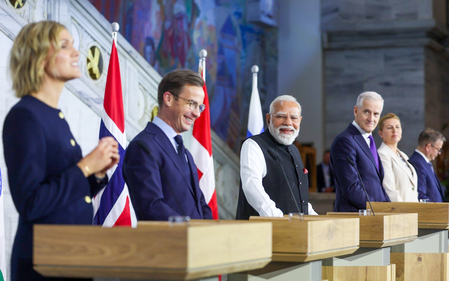
New Delhi, June 6 (IANS) The India-Nordic Summits have served as the institutional cornerstone of engagement, facilitating structured dialogue between New Delhi and the five Nordic countries and deepening cooperation in maritime security, the blue economy, and sustainable infrastructure.
These are not ceremonial exchanges but a reflection of India’s calculated effort to embed itself in the ongoing reconfiguration of global supply chains across democratic economies, a report has stated.
“For centuries, the dream of a navigable Arctic passage was the preserve of explorers willing to risk frostbite and oblivion. Today, that dream has become a geopolitical strategy. As climate change unlocks the Northern Sea Route (NSR), stretching across Russia’s Arctic coastline from the Barents Sea to the Bering Strait, a new commercial and strategic highway is emerging, one that could cut shipping distances between East Asia and Europe by nearly 40 per cent, compared to the traditional Suez Canal route,” a report in ‘India Narrative’ detailed.
“For India, a nation at the crossroads of the Indo-Pacific and increasingly integrated into Northern European strategic thinking, this is not merely a logistical opportunity. It is a civilisational pivot,” it added.
According to the report, India is entering this space with growing strategic maturity, closely watching how the Nordic-Baltic Eight—Denmark, Estonia, Finland, Iceland, Latvia, Lithuania, Norway, and Sweden—have reshaped their security architectures after Finland and Sweden joined the North Atlantic Treaty Organisation (NATO).
“These nations now view the Euro-Atlantic and Indo-Pacific not as separate theatres but as a single, interconnected strategic space. India, occupying a unique position as both a frontline Indo-Pacific power and a historic interlocutor with Russia, is threading a needle that few other nations can manage, engaging the Nordic-Baltic world substantively while preserving strategic autonomy,” it noted.
The report highlighted the compelling strategic and economic case for India’s Arctic engagement, noting that a functional Northern Sea Route would significantly cut transit times for global goods, thereby reducing fuel costs and carbon emissions.
“Nordic expertise in green shipping, offshore wind, and Arctic-grade infrastructure aligns naturally with India’s own green transition ambitions. Estonia’s e-governance frameworks and the Baltic states’ advanced cybersecurity ecosystems complement India’s Digital Public Infrastructure(DPI) revolution, from UPI to digital identity, and can create fertile ground for technology partnerships that bypass high-risk vendors,” it mentioned.
Advocating a “Queen’s Gambit” approach for India, the report noted that with the Northern Route opening, New Delhi must move swiftly to seize the initiative, arguing that greater decisiveness would enhance its capacity to influence regional governance.
“By acting now, India ensures it helps define the rules of engagement rather than merely accepting terms as a latecomer. For a nation that has spent decades learning to play the long game, the Arctic offers both the invitation and the urgency to act. The ice is melting. The opportunity is not,” it stated.
–IANS
scor/ksk/as