

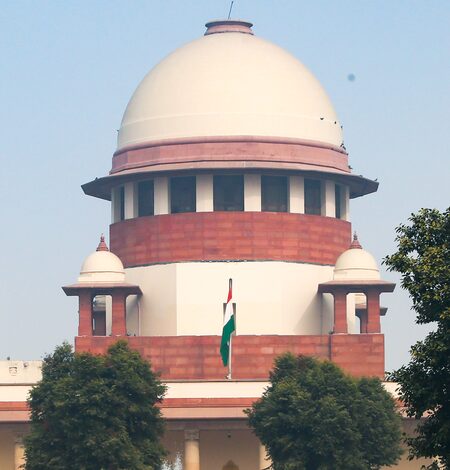
New Delhi, July 30 (IANS) The Supreme Court has observed that a High Court judge ought not to hear and pass orders in a matter involving a former client, particularly where the dispute concerns the very same subject matter in which they had earlier appeared as counsel, stressing that “justice must not only be done but must also be seen to be done”.
A bench of Justices Sanjay Kumar and Sanjeev Sachdeva made the observations while disposing of special leave petitions (SLPs) filed by Prateek Resorts and Builders Private Limited challenging a series of interim orders passed by a judge of the Uttarakhand High Court in connection with criminal writ proceedings concerning a land dispute.
It found that the High Court judge had earlier appeared as counsel for Prateek Resorts and Builders Private Limited in a 2013 writ petition involving the very same parcel of land that later became the subject matter of inquiry in the criminal writ petition before him.
In such circumstances, “in the interest of judicial propriety”, the judge ought not to have entertained the matter or passed orders in it, the apex court held.
“Trite to state, justice must not only be done but must also be seen to be done. Passing orders either in favour of or against a former client, a private entity, does not further that cause,” the Justice Sanjay Kumar-led Bench observed.
It also took exception to the manner in which the scope of the writ petitions had been expanded through the interim orders.
The apex court observed that the two writ petitions had been filed on “altogether different issues” and that their scope had subsequently been enlarged by the judge to address matters which were not connected with the original issues before the High Court.
“Even if such an exercise was taken up with the best of intentions, it was not proper for the learned Judge to do so in writ petitions which had nothing to do with the issues sought to be addressed,” it said.
It added that if the judge believed the matter required consideration in public interest, the proper course would have been to place it before the High Court’s Public Interest Litigation (PIL) Committee or refer it to the Chief Justice for appropriate action in accordance with established procedure.
However, the apex court declined to interfere with the interim orders at this stage, observing that certain orders were presently holding the field and undertakings had also been given regarding not cutting down trees.
“It is for the appropriate Bench of the High Court, as and when it takes up the matter, to go into all aspects on facts and in law, including the validity of the orders impugned presently. All issues are left open to be addressed before the said Bench,” the Supreme Court said.
The apex court directed that its order be communicated to the Chief Justice of the Uttarakhand High Court for taking suitable steps regarding the listing of the two criminal writ petitions before an appropriate Bench, besides considering initiation of a public interest litigation, if warranted.
–IANS
pds/vd