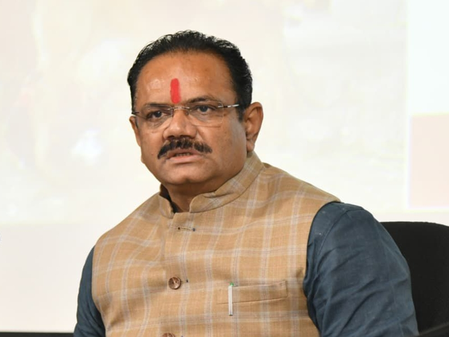
Gandhinagar, March 14 (IANS) The Gujarat government will introduce deep-sea fishing vessels and a first-of-its-kind “mother vessel” support system for offshore fishing as part of new initiatives outlined in the state’s agriculture budget, Agriculture Minister Jitu Vaghani said on Saturday.
During a press conference detailing the department’s proposals, the minister said the state plans to encourage fishermen to venture further into deep waters beyond 12 nautical miles by introducing a ‘Deep Sea Fishing Vessel Scheme’ aimed at tapping the fish production potential in areas beyond Gujarat’s coastal territorial waters and within the Exclusive Economic Zone.
Under the scheme, fishermen will be supported to adopt modern and safer fishing practices in deep-sea areas.
Targeted fishing methods such as hook-and-line and tuna fishing are expected to help increase fish production.
The government has fixed the unit cost of a deep-sea fishing vessel at Rs 1.2 crore, with financial assistance of up to 50 per cent of the cost, capped at Rs 60 lakh, or 50 per cent of the actual expenditure, whichever is lower.
For the 2026-27 financial year, the government has set a target of 30 vessels and allocated Rs 15 crore for the programme.
Vaghani said the government would review demand for the scheme. “If required, the government will adopt a positive approach towards increasing the target,” he said.
The state also plans to implement what it described as a first-of-its-kind “Mother Vessels” scheme in India’s fisheries sector.
These large vessels, also referred to as carrier, receiver or factory vessels, will operate in deep waters and provide logistical and processing support to fishing boats working at sea.
According to the minister, the vessels will have facilities for hygienic landing of fish, sorting, pre-processing, processing and storage on board.
Fishermen will be able to transfer their catch directly to the mother vessel while still at sea, allowing the catch to be handled and exported with maintained quality.
He said the vessels would also provide fuel, water, food and technical support to smaller fishing boats operating for long durations in deep waters.
The scheme aims to expand fishing activity in areas beyond 60 nautical miles from the coast that are currently underutilised. The unit cost of a mother fishing vessel has been fixed at Rs 50 crore, with government assistance of 25 per cent, or up to a Rs 12.5 crore.
Fisheries cooperative societies, Fish Farmers Producer Organisations (FFPOs) and private companies will be eligible to participate in the scheme.
In agriculture infrastructure, the government has expanded assistance under the ‘Crop Storage Structure Scheme’ to help farmers build small warehouses at the farm level.
The size limit for such structures has been increased from 300 square feet to 600 square feet, while financial assistance has been raised from Rs one lakh to Rs two lakh per unit. Budget allocation for the scheme has been doubled to Rs 154 crore.
The minister also announced plans to expand production of sexed semen doses at the laboratory in Patan operating under the National Gokul Mission.
The facility has so far produced eight lakh doses, resulting in the birth of more than 31,263 female calves, with a reported success rate of over 90 per cent.
While the actual cost of a dose is about Rs 700, the government is making it available to livestock rearers at Rs 50.
Another eight lakh doses will be produced in the coming period, supported by a Rs 13 crore provision in the 2026–27 budget.
Vaghani said the technology would help increase milk production and reduce the problem of stray cattle in the state.
The state also plans to expand grain storage capacity across rural, taluka and district levels in line with the central government’s cooperative-sector grain storage programme.
Currently, much of Gujarat’s storage infrastructure is concentrated in urban areas, often forcing farmers to sell produce at lower prices after harvest.
Under the new plan, the network of more than 10,000 agricultural credit societies, over 28,000 purchase and sale unions and 23 milk unions will be involved in developing scientific storage infrastructure.
The government has allocated Rs 30 crore for the initiative. Newly constructed warehouses may also be used by the Food Corporation of India for storage, allowing cooperative institutions to earn rental income.
The minister also announced a token budget provision of Rs 10 crore for a proposed “Gujarat Agri Business and Export Promotion Policy 2026”.
The policy is intended to promote value addition, food processing, reduction of post-harvest losses and development of farm-gate processing facilities.
It will also seek to support agri-based industries, agri-tech startups and investment in food processing, while encouraging quality improvement, branding and marketing of agricultural products to expand exports.
Beneficiaries under the proposed framework are expected to include agri-business and food processing units, organisations providing agricultural services such as custom hiring centres and testing laboratories, agri-startups offering technology-based services, as well as farmer producer organisations, self-help groups and cooperative institutions.
The policy will also support agricultural infrastructure projects under the public–private partnership model, including agri and food parks, irradiation centres, airport cargo facilities, laboratories, agri malls and local grading markets.
In some cases where land is provided by the state at concessional rates or free of cost for PPP projects, assistance of up to Rs 50 crore may be provided.
“The policy aims to promote value addition, strengthen agri-business and increase the share of Gujarat in agricultural exports while creating new employment opportunities in rural areas,” Vaghani said.
–IANS
mys/pgh