
Mumbai, Sep 3 (IANS) Maharashtra Chief Minister Devendra Fadnavis on Thursday said that planning has been executed on a cluster development model for the overall redevelopment of Mumbai, with the goal of making the city slum-free over the next decade.
The face of Mumbai is set to undergo a major transformation through the Dharavi Redevelopment Project, the revitalisation of MHADA (Maharashtra Housing and Area Development Authority) colonies, and the modern redevelopment of BEST (BrihanMumbai Electric Supply and Transport) bus depots.
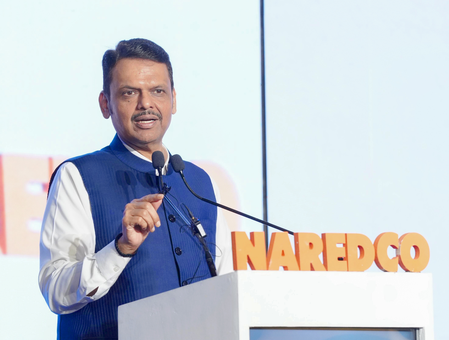
He was speaking at NAREDCO Maharashtra’s ‘Change of Guard’ ceremony.
CM Fadnavis highlighted that NAREDCO has consistently prioritised real estate reforms, the ease of doing business, and the welfare of the entire business community. During the drafting of Mumbai’s Development Plan, real estate bodies including NAREDCO, MCHI, and CREDAI worked shoulder-to-shoulder with the government, resulting in a progressive growth framework for the city.
While the country recorded a growth rate of 7.8% in the first quarter, Maharashtra achieved an 8.8% growth rate during the same period. The Chief Minister credited the real estate sector for playing a pivotal role in driving this growth. The next phase of Mumbai’s growth centres around redevelopment. Utilising a cluster-based planning approach, the Dharavi Redevelopment Project has already commenced, with a target to deliver 10,000 rehabilitation housing units by January 2029.
Additionally, CM Fadnavis stressed the urgent need to redevelop 50-year-old MHADA colonies, ensuring planned development by maximising the efficient use of available land resources. To modernise the city’s lifeline, BEST bus depots will undergo state-of-the-art redevelopment. These sites will feature modern bus stations, upgraded passenger amenities, commercial and residential spaces, alongside museums, sports grounds, and recreational hubs. This mixed-use approach will generate new revenue streams for BEST while drastically reshaping Mumbai’s urban design, said the CM.
According to Fadnavis, the Mumbai Metropolitan Region (MMR) development plan is structured to scale MMR’s economy to $1.5 trillion by 2047. Next-generation urbanisation is set to accelerate rapidly across MMR, Pune Metropolitan Region, and Nagpur Metropolitan Region. MMR currently hosts nearly 60% of India’s data centre capacity, with plans underway to build robust ecosystems for smart manufacturing, frontier technologies, and deep tech.
“Mumbai 3 is no longer just a future concept—its implementation has begun. Various urban hubs, including Smart Cities, Edu-Cities, Medi-Cities, and Innovation Cities, are actively being developed. Furthermore, a 24-kilometre sea link from Uttan to Virar will be constructed, serving as a critical infrastructure project to speed up traffic flow and render Mumbai signal-free,” he said.
Vadhavan Port—nearly three times larger than JNPT—is poised to chart a new path for the country’s maritime economy. The port alone is expected to generate approximately 1 million job opportunities in Palghar district. This expansion requires new urban centres, laying the foundation for the development of ‘Fourth Mumbai’, said the Chief Minister.
Plans are also in place for a dedicated freight corridor linking Vadhavan Port and JNPT to Nashik, with further connectivity to Jalna, Wardha, and Gadchiroli via the Samruddhi Expressway. This will extend the benefits of port-led development to every corner of Maharashtra, he noted.
CM Fadnavis said that in Nagpur, ‘New Nagpur’ is being developed with plug-and-play facilities for industries, and real estate developers have been urged to capitalise on these emerging opportunities. In Pune, land acquisition for the new airport is complete, and the tendering process for construction will launch this year. The area surrounding the new airport is slated for Global Capability Centres (GCCs) and smart manufacturing ecosystems. The state government also aims to establish the Mumbai-Pune corridor as a ‘Quantum Corridor’. With 65% of India’s population being young—including nearly 30 million youth aged 18 to 28 in Maharashtra—this tech-savvy generation will unlock new avenues for economic progress.
Artificial Intelligence is set to fundamentally reshape jobs and business models, making it essential for the construction sector to adopt modern technology for faster, advanced construction techniques, he remarked.
Extending his best wishes to Raunak Bandelkar and his newly appointed team at NAREDCO Maharashtra NextGen, Chief Minister Fadnavis remarked that a strong partnership between the government and the real estate industry will steer Maharashtra’s urban development in a bold new direction.
During the event, an agreement was exchanged between NAREDCO Chairman Kamlesh Thakur and Nagpur NMRDA Commissioner Sanjay Meena in the presence of Chief Minister Fadnavis, along with the official unveiling of the “New Nagpur” logo.
–IANS
sj/uk