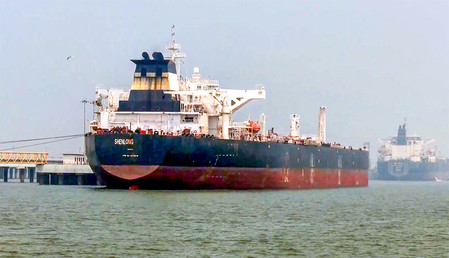
New Delhi, March 15 (IANS) The image of a ship carrying cooking gas safely heading home may not ordinarily evoke strong emotions. But in a world shaken by conflict and uncertainty, the sight of two Indian-flagged LPG carriers cutting through the tense waters of the Strait of Hormuz felt like something more than routine maritime movement. It felt like reassurance.
At a time when the US-Israel-Iran confrontation threatens to destabilise one of the world’s most critical energy corridors, the successful passage of the Indian vessels ‘Shivalik’ and ‘Nanda Devi’ has quietly demonstrated the strength of India’s diplomatic balancing. In the midst of a volatile geopolitical storm, New Delhi managed what many countries struggle to do — protect its strategic interests without being dragged into the conflict.
The two LPG tankers, owned by the Shipping Corporation of India (SCI), began their journey back home after what officials described as a “carefully coordinated operation” conducted with the cooperation of Iran and other regional stakeholders. Such operations rarely happen overnight.
Behind the scenes were multiple diplomatic engagements, sensitive negotiations, and constant monitoring of developments in a rapidly evolving conflict zone.
The breakthrough reportedly came after several rounds of inter-governmental discussions between India and Iran. Prime Minister Narendra Modi held a telephonic conversation with Iranian President Masoud Pezeshkian, while External Affairs Minister S. Jaishankar engaged with his Iranian counterpart Seyed Abbas Araghchi on issues related to maritime safety and energy security.
For India, the significance of this development extends far beyond the safe movement of two ships. The Strait of Hormuz is one of the world’s most important energy arteries, through which a large portion of global oil and gas shipments pass. Any disruption there has immediate implications for countries dependent on energy imports, including India.
In that context, the safe transit of Shivalik and Nanda Devi sends a reassuring message to Indian households. It indicates that even in the midst of international tensions, India’s diplomatic and logistical mechanisms remain capable of safeguarding critical supplies.
The development has also unfolded against the backdrop of a heated political debate at home. The Opposition, particularly the Congress party, has questioned the government’s foreign policy choices during the ongoing West Asian crisis. Congress leader Rahul Gandhi has said that India has drifted away from its traditional non-aligned stance and is moving closer to the US and Israel.
According to Gandhi, such a tilt could potentially damage India’s long-standing ties with Iran and undermine strategic initiatives like the Chabahar port project.
Speaking in the Parliament premises recently, the Lok Sabha Leader of Opposition suggested that India’s energy security had been “compromised due to flawed foreign policy decisions” and alleged that the government had effectively allowed Washington to influence its relationships with oil suppliers.
In a healthy democracy, criticism of government policy is both legitimate and necessary. But the larger global reality must also be acknowledged. The tensions between the US-Israel and Iran are not an isolated regional dispute; they have the potential to affect global energy markets, shipping routes, and economic stability.
If the conflict intensifies or stretches into a prolonged confrontation — as seen in the Russia-Ukraine war — its ripple effects will be felt across continents. In such circumstances, governments worldwide are focused on ensuring domestic stability while maintaining diplomatic channels abroad.
India is no exception. The priority in such moments is to ensure that citizens do not face unnecessary disruptions in essential supplies. Panic and speculation can often create bigger crises than the conflict itself.
So far, the situation on the ground suggests that fears of an immediate energy disruption have not materialised. Petrol prices have remained stable, piped natural gas continues to be supplied in urban areas, and LPG cylinders are still reaching households.
Authorities have, however, cautioned against panic buying and hoarding. In one unusual incident reported from Hapur district in Uttar Pradesh, officials seized 55 LPG cylinders from the residence of a Samajwadi Party leader amid rumours of shortages. This was shocking, as SP leaders have been very vocal about the potential gas crisis.
The Opposition has been very aggressive over the cooking gas situation, has criticised the government’s responses to developments involving Iran’s Supreme Leader Ayatollah Ali Khamenei, and questioned whether India’s claim of “strategic autonomy” is gradually tilting toward Washington. Rahul Gandhi has been attacking the government vehemently, using words like ‘compromise’.
But the facts on the ground indicate a clear diplomatic reality. If India had indeed abandoned its independent foreign policy space, it is difficult to imagine Iran facilitating the safe passage of Indian-flagged vessels through the Strait of Hormuz during a period of heightened tensions. Similarly, India recently allowed an Iranian naval ship to dock in Kochi for logistical assistance — an act that reflects continued engagement rather than diplomatic distance.
These developments underline the nature of India’s evolving foreign policy approach. Rather than rigid alliances, New Delhi increasingly pursues what policymakers describe as “multi-alignment” — maintaining functional relations with competing global powers while prioritising national interests.
In a world where geopolitical rivalries are intensifying, this balancing act is not easy. But it allows India the flexibility to navigate crises without becoming entangled in them.
Ultimately, diplomacy is often most effective when it works quietly, away from the glare of political noise. The journey of Shivalik and Nanda Devi through one of the world’s most sensitive maritime corridors is a reminder of that truth.
The real story of those ships goes far beyond cargo moving across the sea. It is the story of a nation ensuring that, even in the midst of global turbulence, its vital lifelines continue to flow — steady, silent, and secure. For once, Rahul Gandhi could acknowledge this reality, for it concerns India and the strength of its diplomacy, not the fortunes of the BJP. But that, one suspects, is unlikely to happen.
(Deepika Bhan can be contacted at deepika.b@ians.in)
–IANS
dpb/sd/