
‘Empowered or Oppressed?’: Tracing the feminine fate across the ancient Indian ethos (IANS Book Review)

New Delhi, July 14 (IANS) The feminine, leaving aside the sacred feminine motif present in several religions, is not just a concept of the human condition but rather a facet of creation itself, given its role in gestation and nurturing. Even if it is viewed as half of the equation of life, it unfortunately does not reflect in the social configuration, or the infamous patriarchy, which long deprived women of their due status and agency.
In the Indian context, the question that crops up is whether it was always like this, given that this inequality is purported to be rooted in the hoary annals of “traditional and/or scriptural authority”. Or is this ruse another colonial construct, rooted in selective interpretation or mischievous misinterpretation in pursuance of vested interests?
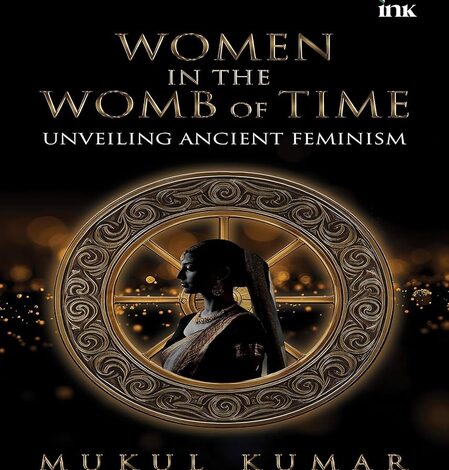
This is what civil servant Mukul Kumar seeks to investigate in his first non-fiction work, “Women in the Womb of Time: Unveiling Ancient Feminism” (BluOne Ink Pvt/328 pp/Rs 799), with his basic question being to find out “how did the discrimination against women emerge?”
This he seeks to answer by undertaking a comprehensive and intense scrutiny of ancient texts and other evidentiary material to see what they tell us about the status of women in hoary antiquity.
And what he finds is quite eye-opening, not to mention counter-intuitive!
But before beginning what proves to be a most extensive – yet lucidly-presented – survey into Ancient India’s social mores and norms, Mukul Kumar, an Indian Rail Traffic Service officer whose previous published oeuvre comprises half a dozen works split between novels and poetry anthologies, seeks to clarify his terms of reference and yardsticks, particularly the contested definitions of the binary constructs of ‘feminity’ and ‘masculinity’.
This entails an engrossing philosophical, historical, and anthropological excursion into the genesis and development of human society and gender roles and the definition and scope of feminism, which draws in Karl Marx – and his theory of the influence of the means of production, his collaborator Friedrich Engels, Simone de Beauvoir, Judith Butler, and more.
With this done, the author then begins his examination with the ‘Shruti’ literature, encompassing both the venerable Vedas, particularly the Rig Veda, as well as the Upanishads, and the ‘Smriti’ literature, which includes both the great epics – the Ramayana and the Mahabharata, the Shastras, and the Puranas.
And in the process, he brings the spotlight on several female luminaries of the Vedic period, of which Gargi, Maitreyi, and Lopamudra are known, but also the likes of Viswavara and Apala who deserve more attention.
Similarly, he does strike new ground in his study on epic literature, where the focus is not only on Sita and Draupadi, but several other key characters, both central and cited, like Tara, Mandodari, and Savitri, among others.
More significantly, Mukul Kumar delves deep into the Manusmriti, the Arthashastra, and the Kamasutra, all of which get their separate chapters.
Explaining his choice of the trio, he says the first needs an examination for its contradictory nature on the subject (among other issues), the second for being the first Indian work to deal with the role of women in the economic domain beyond their home and hearth, and finally, the last, which is not, as commonly perceived, only a manual of erotic love but a more wider work of social customs and advice.
Varying traditions across the subcontinent, including Buddhism and Jainism, are then taken up for how they deal with the issue of women, before the author moves on from his scriptural exegesis to what extant epigraphical and numismatic evidence tells us before wrapping up his quest in the Gupta era of the 7th Century C.E. – and the wider landscape of the sub-continent – to reflect on what his research indicates.
The course of the journey is most engrossing, not to mention cerebral but accessible at the same time, for the author does wear his erudition lightly and despite the profuse quotations from the source works, presents his work as more of an informed conversation than a discourse.
And then, along with his own reading of the matter concerned, Mukul Kumar marshals the thoughts of a considerable number of domain and other experts, including (but not limited to) Mahatma Gandhi, Sri Aurobindo, Romila Thapar, Radha Kumud Mukherjee, D.N. Jha, Wendy Doniger, et al.
In all, it is a thought-provoking excursion into a period of early Indian civilisational ethos, with its sets of binary opposites, and an aim of seeing how far the “ancient articulations are resonant with current feminist concerns”, but based on indigenous intellectual and cultural heritage, instead of Western interpolations.
While the author does add the caveat that his work shouldn’t be seen as definitive but as the beginning of informed exploration, it certainly is an impressive start.
(Vikas Datta can be contacted at vikas.d@ians.in)
–IANS
vd/
