
El Nino: Agriculture Minister calls for advance contingency planning in rain-deficient districts

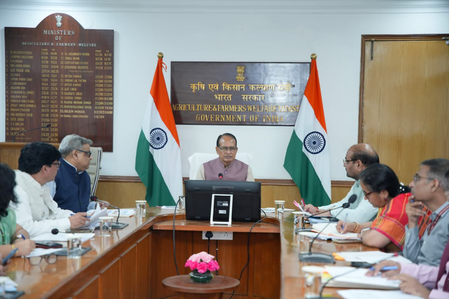
New Delhi, June 16 (IANS) As the El Nino threat looms, Union Agriculture Minister Shivraj Singh Chouhan on Tuesday stressed the need for advance contingency planning in rain-deficient districts, while also pushing for increased acreage under cotton and pulses.
In a high-level weekly agriculture review meeting with senior officials held at Krishi Bhawan here, a detailed review was conducted of the nationwide preparations for Kharif 2026.
During the meeting, while discussing the possible El Nino situation, officials were directed to ensure complete preparations in advance in those districts where there is a likelihood of low rainfall or uneven distribution of rains.
“Such districts should be identified, and crop-wise contingency plans should be prepared in collaboration with state governments, so that in the event of any weather-related challenge, farmers can be immediately provided with alternatives, advice, and assistance,” Chouhan said.
While reviewing the crop-wise targets, sowing progress, and state-wise preparations for Kharif 2026, there was a special discussion on increasing cotton production.
“Emphasis was placed on promoting measures such as scientific methods, selection of appropriate varieties, intercropping, mulching, and moisture conservation on a large scale, so that both cotton productivity and farmers’ income can increase,” the minister said in a post on X.
There was also a detailed discussion on the Pulse Self-Reliance Mission.
“Our effort is to make the country increasingly self-reliant in pulses like pigeon pea, black gram, and green gram, and to secure farmers’ income,” said the minister.
The government is already preparing for a weaker monsoon due to the El Nino phenomenon. India is better positioned to withstand the impact of a potentially weak monsoon and emerging El Nino conditions this year, backed by higher reservoir levels, record foodgrain stocks and structural improvements in the economy.
Reservoir storage levels stood at 30.4 per cent of full reservoir capacity in May 2026, higher than the average 25.1 per cent recorded during previous El Nino years between 2015-16 and 2023-24, according to latest data.
–IANS
na/