

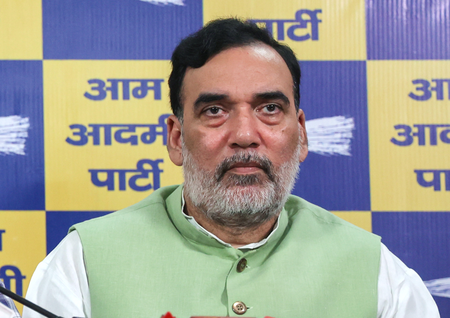
New Delhi, May 22 (IANS) The Delhi High Court on Friday issued notices to Aam Aadmi Party (AAP) leader Gopal Rai and investigative journalist Saurav Das in a criminal contempt petition alleging circulation of scandalous and contemptuous social media content against Justice Swarana Kanta Sharma in connection with the excise policy case.
The petition, filed by Ashok Chaitanya under Section 15(1)(c) of the Contempt of Courts Act, 1971, read with Article 215 of the Constitution, had also sought initiation of contempt proceedings against AAP national convenor and former Chief Minister Arvind Kejriwal and party leader Saurabh Bharadwaj.
However, a Bench of Justices Navin Chawla and Ravinder Dudeja observed that Kejriwal and Bharadwaj had already been issued notices in the suo motu criminal contempt proceedings initiated earlier by the Delhi High Court.
It directed that the two matters be heard together and listed them for the next hearing on August 4.
The Delhi High Court directed the newly impleaded proposed contemnors to file their replies before the next date of listing and ordered the Registry to preserve the social media material relied upon in the latest petition.
It further directed that Kejriwal, Bharadwaj, and senior advocate Rajdipa Behura — the amicus curiae appointed to assist the court — be provided with copies of the petition and supporting material. “We also appoint Ms. Rajdipa Behura, Senior Advocate, as Amicus Curiae to assist the Court in this case. A copy of the paperbook be supplied to the learned Amicus Curiae by the Registry of this Court,” the order stated.
The petition stated that after the trial court discharged Kejriwal and other accused persons in the alleged excise policy corruption case, the CBI moved a criminal revision petition before the Delhi High Court, which came to be listed before Justice Swarana Kanta Sharma.
As per the petitioner, attempts were subsequently made seeking the transfer of the matter and recusal of Justice Sharma from hearing the case. The petition alleged that while the recusal application was pending, the respondents carried out a “concerted and orchestrated campaign” on social media platform X, publishing and amplifying posts containing “serious, unfounded, and scandalous allegations” against the judge.
It further claimed that the impugned posts attempted to portray the judge as biased and raised allegations of conflict of interest and impropriety based on purported professional engagements of her family members.
Earlier, on Tuesday, the Delhi High Court had issued notices to Kejriwal, former Deputy Chief Minister Manish Sisodia, Rajya Sabha member Sanjay Singh and other AAP leaders in suo motu criminal contempt proceedings initiated over alleged attempts to scandalise the judiciary in connection with the excise policy case.
In its order, a Division Bench of Justices Navin Chawla and Ravinder Dudeja recorded that the contempt proceedings had been initiated based on an earlier order passed on May 14, in which Justice Swarana Kanta Sharma had taken exception to material allegedly circulated against the judiciary in a “derogatory” manner.
“The proceedings have been initiated on the basis of the order dated May 14. The single judge has placed reliance on the material from social media posts and other electronic and publication records. The Registry is directed to preserve copies of the same and place them before this Court,” the Delhi High Court had observed. It had issued notices to the alleged contemnors, including AAP leaders Saurabh Bharadwaj, Vinay Mishra and Durgesh Pathak, granting them four weeks to file their replies.
The contempt proceedings stemmed from an order passed by Justice Sharma, who had observed that a “coordinated social media campaign” was carried out to scandalise the judiciary after she refused to recuse from hearing the excise policy case.
In a detailed order, Justice Sharma had held that the actions of the proposed contemnors were “calculated to scandalise the Court, lower the authority of the institution of justice, interfere with the administration of justice, and intimidate the independent exercise of judicial functions”.
The judge had observed that while criticism of judicial orders is permissible, there exists “a very thin line” between fair criticism and attempts to portray a judge as biased through organised campaigns.
“The Court cannot permit erosion of the constitutional system and the justice delivery mechanism by tolerating such assaults in the name of public discourse,” the order had said.
Justice Sharma later recused herself from hearing the excise policy case, observing that the matter could be assigned to another Bench to avoid any perception of bias.
Following the recusal, Justice Manoj Jain was assigned to hear the CBI’s revision plea challenging the trial court order discharging Kejriwal, Sisodia and others in the alleged corruption case linked to the now-scrapped excise policy.
The trial court, in a judgment spanning more than 1,100 paragraphs, had discharged all accused persons, holding that the now-scrapped excise policy was the outcome of a consultative and deliberative process and that the prosecution failed to establish any overarching conspiracy.
In its revision petition before the Delhi High Court, the CBI has alleged that the excise policy framed by the then AAP-led Delhi government was manipulated to favour select liquor traders in exchange for kickbacks.
–IANS
pds/dpb