

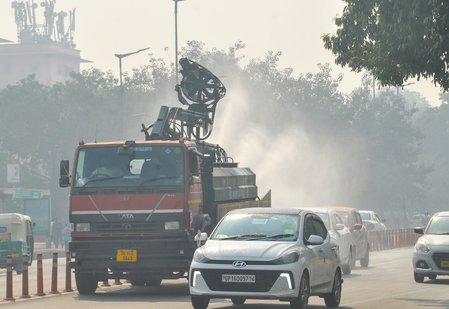
New Delhi, Oct 5 (IANS) Delhi’s air quality remained in the ‘moderate’ category on Monday, although several parts of the national capital recorded pollution levels in the ‘poor’ category, according to data from the Central Pollution Control Board (CPCB).
As per CPCB data, overall air quality in Delhi remained moderate, with several monitoring stations reporting elevated pollution levels. Mandir Marg recorded an AQI of 146, Aya Nagar 140, Punjabi Bagh 212, CRRI Mathura Road 225, Shadipur 175, IGI Airport (T3) 187, Alipur 238, JNU 135, R.K. Puram 193, Mundka 257, Wazirpur 221, Vivek Vihar 230, Okhla Phase-2 203, Cantonment Area 87, Nehru Nagar 144 and Anand Vihar 179.
The deterioration in air quality comes as Delhi enters the period when pollution levels typically begin to rise sharply. The national capital had witnessed its most polluted start to October in recent years, with the situation worsening over the past few days.
On Sunday, Delhi recorded its worst air quality of the season, with the city’s average AQI reaching 187, placing it at the higher end of the ‘moderate’ category.
The rise in pollution follows a brief period of relatively cleaner air, when rainfall and strong winds helped disperse pollutants. However, declining wind speeds, the absence of rain and localised emissions have contributed to the renewed deterioration in air quality.
PM10, consisting largely of coarse and inhalable particles originating from sources such as road dust, construction activity and biomass burning, has been among the major pollutants during the recent deterioration.
Of the 43 operational air quality monitoring stations in Delhi, 14 recorded AQI levels in the ‘poor’ category in the average 4 p.m. bulletin. Mundka reported the highest AQI at 273, followed by 257 at both CRRI Mathura Road and Narela, while Jahangirpuri recorded an AQI of 237.
The Delhi Cantonment area recorded the lowest AQI at 97, falling in the ‘satisfactory’ category.
Under CPCB’s classification, an AQI between zero and 50 is considered ‘good’, 51-100 ‘satisfactory’, 101-200 ‘moderate’, 201-300 ‘poor’, 301-400 ‘very poor’ and 401-500 ‘severe’.
CPCB data also indicated that Delhi has witnessed one of its most polluted starts to October in the last six years. The average AQI during the first four days of October was 174.5 in 2026, compared with 119.75 in 2025, 167.25 in 2024, 155 in 2023, 161.25 in 2022, 107.25 in 2021 and 176.25 in 2020.
Air quality in Delhi-NCR generally begins deteriorating from mid-September. Stubble burning, followed by emissions from vehicles, industries, power plants and biomass burning, contributes significantly to winter pollution. Firecrackers during the festive season, particularly around Diwali, can further aggravate the situation despite restrictions.
The Commission for Air Quality Management’s expert assessment has identified PM2.5 as a key pollutant affecting Delhi’s air quality, with secondary particulates formed from various combustion-related emissions contributing significantly during winter.
–IANS
jk/dpb