
Critically endangered gharial returns to Kaziranga National Park in major conservation milestone

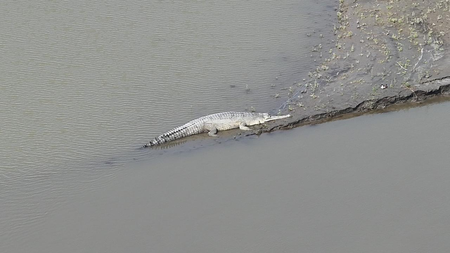
Guwahati, May 10 (IANS) Once feared to have vanished from Assam’s river systems, the critically endangered gharial has been sighted once again in Kaziranga National Park, marking a remarkable and encouraging moment for wildlife conservation in the region, officials said on Sunday.
The rare sighting has sparked hope among conservationists and wildlife experts, highlighting the success of ongoing efforts to restore and protect the state’s fragile riverine ecosystem.
Kaziranga National Park and Tiger Reserve (KNPTR) Director Sonali Ghosh said that on April 26, a gharial (Gavialis gangeticus) was spotted basking on a sand bar near the Maite anti-poaching camp area of Burapahar Range of the park.
The sighting was reported by a team of Forest staff while on patrolling duty along the confluence of Difolu and Brahmaputra River, she said.
Experts say that river confluences and sandy banks are the preferred habitat of gharials for feeding, basking, and breeding.
Ghosh said that since then, more such sightings were reported with photographic proof from the same location in the following days. The last reported sighting was on May 8, from Burapahar Range by tourist guide Shishukanta Nath, which was widely welcomed on social media.
Assam Chief Minister’s Office (CMO), while taking to social media, posted: “Once believed to have disappeared from Assam’s river systems, the critically endangered gharial has now been spotted at Kaziranga, a truly remarkable moment for wildlife conservation.”
KNPTR Director said that for tourists and forest officials alike, this was more than just a rare sighting.
“It was a powerful reminder of Assam’s extraordinary biodiversity and the silent success of sustained conservation efforts across our forests, wetlands and rivers,” the senior Indian Forest Service officer said.
The gharial is a specialised, fish-eating reptile identifiable by its very long, thin snout. It is listed as critically endangered due to a historical 98 per cent population decline and an estimated 650-1,000 mature breeding individuals left in the wild, Ghosh said.
She informed that major remaining wild populations (gharial) and reintroduction sanctuaries are located near the National Chambal Sanctuary (Madhya Pradesh, Rajasthan, Uttar Pradesh), Katarniaghat Wildlife Sanctuary (Uttar Pradesh), and the Gandak River (Bihar).
As an apex predator and keystone species, it acts as an indicator of river health, playing an essential role in regulating fish populations and keeping freshwater ecosystems balanced.
Their historical decline in Assam was largely driven by habitat degradation and changing river dynamics.
The KNPTR Director said that occasional sightings of gharial in the Brahmaputra were also reported historically from Dibru Soikhowa National Park, Manas National Park, and Dikhow and Subansiri river basins of Sibsagar and Lakhimpur districts of Assam.
She said that gharials historically inhabited the Brahmaputra River system in Northeast India, with records from the 1950s across sixteen rivers in the region. The species was considered locally extinct there after the 1950s due to habitat loss and other factors, though unconfirmed sightings were reported for single individuals occasionally.
Ghosh said that such sightings indicate a possible continuous presence of the reptile in Assam, although the species was thought to be locally extinct. The sightings are seen as a strong indicator of successful ecological preservation and long-term wetland conservation initiatives across Assam’s protected areas.
The official noted that recent surveys, conducted by Kaziranga Park Authority in collaboration with WII (Wildlife Institute of India), WWF (World Wide Fund for Nature) and TSAFI (Turtle Survival Alliance Foundation India) including one in January 2026 along 160 km of the river, have documented the lone gharial female in the past few years alongside diverse aquatic life, prompting reintroduction proposals from sources like Chambal Conservation Breeding centre wherein Madhya Pradesh government has expressed its willingness to support with the same.
Conservation efforts highlight the Brahmaputra’s potential due to ample fish prey and low human disturbance in protected areas, the official said.
The Kaziranga National Park and Tiger Reserve, India’s seventh UNESCO World Heritage Site, is renowned for its ‘Big Five’ wildlife species — greater one-horned rhinoceroses, Bengal tigers, Asian elephants, buffaloes, and eastern swamp deer. Spread across the districts of Golaghat, Nagaon, Sonitpur and Biswanath, it comprises three forest divisions — Eastern Assam Wildlife Division (Bokakhat), Biswanath Wildlife Division (Biswanath Chariali), and Nagaon Wildlife Division (Nagaon).
–IANS
sc/vd