
Cheetah Gaurav’s death closes chapter of Kuno’s first Namibian coalition, but his bloodline lives on

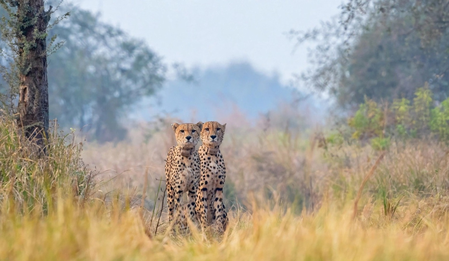
Bhopal, Sep 24 (IANS) Gaurav and Shaurya arrived in India as two brothers from Namibia in the first chapter of the country’s cheetah reintroduction programme. They explored Kuno together, hunted together, fought territorial battles and became the first major coalition to establish itself in their new home. With Gaurav’s death, one of the defining stories of those early days of Project Cheetah has come to an end.
The over 10-year-old Namibian cheetah died during treatment at Madhya Pradesh’s Kuno National Park on September 21, nearly four years after he was brought to India in September 2022 along with seven other cheetahs from Namibia.
Kuno Field Director Uttam Sharma, in an obituary titled ‘Obituary to the Rockstars’, described Gaurav and his brother Shaurya — originally known as Elton and Freddie — as pioneers who helped establish the project in its formative years.
“Some cheetahs arrive in a new land and become part of its history. A few become its legends. Gaurav and Shaurya—Elton and Freddie—were among those special cheetahs,” Sharma said.
The brothers’ arrival was followed by several milestones. They were the first coalition to move from the quarantine boma into the soft-release boma and among the first introduced cheetahs to make a successful kill on Indian soil.
Their presence also brought the first signs of territorial competition among the reintroduced cheetahs. The Namibian brothers confronted the South African coalition of Agni and Vayu and emerged victorious.
For Sharma, such encounters were significant because they showed that the introduced animals were beginning to function as wild predators rather than merely adapting to captivity or surviving in a new environment.
“They were beginning to behave like wild cheetahs, competing, establishing territories and carving out their own place in the ecosystem,” Sharma said.
The brothers’ partnership ended with Shaurya’s death in January 2024. Gaurav survived and continued to hold his territory, although he became quieter and more reclusive.
His legacy, however, extended beyond territorial survival. Gaurav sired three cubs with Nirva, a South African female — two males and a female. Now more than 18 months old, the cubs have become independent and represent a continuing Namibian genetic line within India’s growing cheetah population.
Gaurav’s final journey began on September 12, when he was rescued from the wild after being found weak and dull. Examination revealed severe dehydration, marked weakness and visible muscle wasting.
He was shifted to Palpur and placed in a quarantine boma for close monitoring after receiving systemic and supportive treatment. His condition continued to deteriorate and he died at around 4 p.m. on September 21.
The precise cause of death will be established following a post-mortem examination and analysis of samples.
“Gaurav will always be remembered in Kuno as one of the original pioneers of Project Cheetah: One of the first to establish himself, one of the first to hunt, one of the first to compete, and one of the first to demonstrate that these magnificent animals could begin building their lives again on Indian soil,” Sharma said.
With Gaurav gone, Kuno is home to 51 cheetahs, including 36 Indian-born animals, with 16 ranging freely in the wild. Four more cheetahs at Gandhi Sagar Wildlife Sanctuary take India’s overall cheetah population to 55.
Gaurav’s death, therefore, marks more than the loss of an individual animal. It marks the passing of one of the original pioneers whose life in Kuno helped define the earliest phase of India’s return of the cheetah — while his three independent cubs carry that story forward.
–IANS
pd/rad