
Carbon capture, utilisation and storage to play key role in India’s Net Zero vision

New Delhi, Oct 27 (IANS) Carbon Capture, Utilisation and Storage (CCUS) is an important pathway for reducing emissions from hard-to-abate sectors and can support India’s Net Zero by 2070 vision, while strengthening industrial competitiveness and resource efficiency, according to an official statement issued on Tuesday.
The government is fostering an ecosystem that brings together research institutions, public sector enterprises and private industry. This growing ecosystem spans operational projects, projects under execution and proposed initiatives across multiple states. These efforts are laying the foundation for indigenous CCUS capabilities, carbon utilisation and secure carbon storage.
Renewable energy can significantly lower emissions, but some industrial processes cannot be easily electrified. These include processes requiring very high temperatures or carbon-based inputs. CCUS involves capturing carbon dioxide from industrial sources before its release into the atmosphere.
The captured carbon dioxide can then be utilised in productive applications or stored securely underground. CCUS can, therefore, complement renewable energy and support India’s transition towards a lower-carbon industrial economy.
NITI Aayog identifies CCUS as critical for decarbonising hard-to-abate sectors, including steel, cement, oil and gas, petrochemicals, chemicals and fertilisers. These industries contribute significantly to industrial emissions and face technological challenges in achieving deep decarbonisation.
CCUS can help reduce emissions from existing facilities while supporting the continued production of essential goods. It can also create opportunities for developing new technologies, infrastructure and industrial capabilities in India.
By connecting carbon capture with utilisation and secure storage, the approach can address emissions across multiple stages. CCUS can thus support India’s climate goals while maintaining industrial growth and economic development, according to the statement.
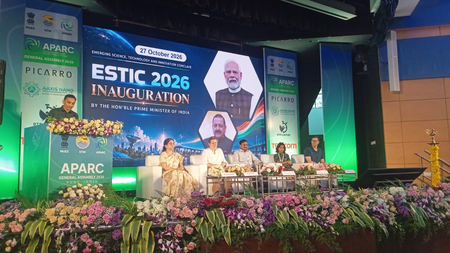
‘ESTIC-2026’, the second edition of India’s Emerging Science, Technology and Innovation Conclave, is being held from October 27–29, 2026 at Bharat Mandapam in the national capital.
Organised by the Council of Scientific and Industrial Research (CSIR), the conclave follows the theme “Creative Minds, Catalyzing Science, Empowering Technologies.” It advances emerging frontiers in science and technology, including energy technologies such as Carbon Capture, Utilisation and Storage (CCUS). Spanning 12 thematic areas, it features plenary sessions, technical discussions and exhibitions.
–IANS
sps/na