

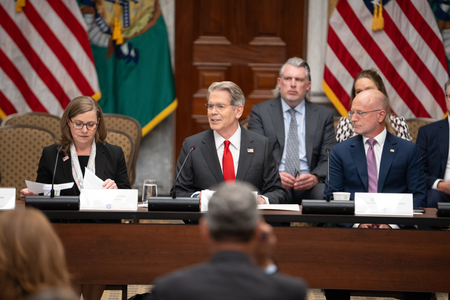
Asheville, Sep 1 (IANS) US Treasury Secretary Scott Bessent has called for faster, more transparent and predictable sovereign debt restructuring as developing economies confront mounting debt burdens, weaker financing flows and growing liquidity pressures.
Addressing a G20 meeting on sovereign debt in Asheville, North Carolina, Bessent said the group would establish a technical-level study group to advance discussions before the G20 Leaders’ Summit in Doral, Florida, in December.
“As we prepare to conclude the G20 presidency, I expect our debt work stream to remain an ongoing priority,” he said.
“Accordingly, to maintain momentum and better inform leaders’ discussions, we will establish a technical-level study group following today’s meeting to continue advancing this important issue now and at the Leaders Summit in Doral in December.”
Bessent said the G20 carried a particular responsibility because its members included many of the world’s largest official creditors as well as some of its biggest borrowing nations.
“That gives the G20 both the responsibility and the capacity to act,” he said.
Many emerging markets and developing economies were facing growing debt stocks and a slowdown in new sources of financing, creating liquidity pressures, Bessent said. Several low- and middle-income countries remained vulnerable to debt distress, while some could ultimately need restructuring.
“Boosting durable growth is critical to enabling them to continue servicing debt and reducing their debt ratios over time,” he said.
Bessent said the US sovereign debt agenda had two principal goals: accelerating restructuring for emerging and developing economies that needed it, and improving the accuracy and transparency of debt data.
“On speed, we want less time consumed by uncertainty and more time devoted to investment, growth, and market access,” he said.
“Similarly, on transparency, we want borrowers and creditors to work from a common set of facts. Better data support better policy, reduce surprises, and strengthen global financial stability.”
Bessent said progress had been made during the year. The G20 had agreed to publish an illustrative template memorandum of understanding, while the Global Sovereign Debt Roundtable had updated its playbook. Both measures were intended to make the restructuring process more transparent.
The US G20 presidency had also consulted private creditors, advisers and borrowing countries on the future direction of the group’s debt-related work, he said.
Those discussions highlighted the need to respond to countries’ liquidity requirements before they entered debt distress. They also underlined the importance of strengthening debt-management capacity and improving information-sharing with private creditors.
Bessent warned of risks arising from “speculative or opaque financing arrangements”.
Future work should address capacity constraints facing borrowers, examine possible external creditor support for managing liquidity and make further progress on debt-data transparency, he said.
Bessent said sovereign borrowing, when managed properly and supported by sound macroeconomic policies, could finance education, healthcare and infrastructure.
“When managed well, supported by strong macroeconomic policy, sovereign debt issuance can fuel investments in education, health, and infrastructure that lead to durable economic growth and improve standards of living,” he said.
–IANS
lkj/ksk/uk