
Behind BJP’s Assam and Bengal sweep, Dalit votes a key factor; TN and Puducherry no exception

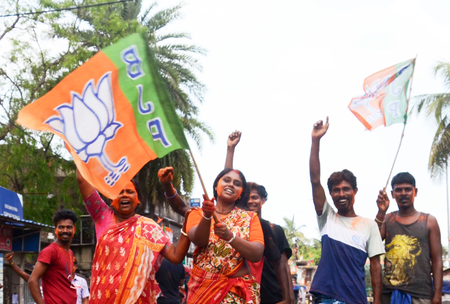
New Delhi, May 6 (IANS) The Bharatiya Janata Party’s (BJP) historic hat-trick victory in Assam and the unprecedented mandate in West Bengal Assembly elections is being seen and analysed as an outcome of its Hindutva politics and “anti-minority” poll plank, however, the real answer, experts argue, lies in its increasing connect with the grassroots level and overwhelming support from the downtrodden and Dalit communities.
Amidst the political sparring over TMC’s connect with Bengali culture and roots, in contrast to BJP’s ‘polarising and communal’ poll pitch, the latter has prevailed over the former’s rhetoric not just in belts with sizeable majority population but also in those where Dalits decide the poll outcome.
The election result numbers, particularly from Scheduled Caste and Scheduled Tribe (SC-ST) communities in almost all states, show a marked and decisive shift towards the BJP as the party went to register victory in seats reserved for the Dalit community. In Assam and Bengal, it won the reserved constituencies in huge numbers, while in Tamil Nadu and Puducherry, the party-led alliance registered victory in a fairly good number of constituencies.
The BJP, usually labelled as the party of Brahmins and upper castes, has managed to gain and consolidate support of Dalit votes with the latter reposing faith in Prime Minister Narendra Modi’s vision of Sabka Saath, Sabka Vikas and Sabka Vishwas.
Assam
Assam, with an Assembly strength of 126 members, has a total of 28 reserved seats. Out of this, nine are reserved for SCs and the other 19 for the ST community. Here, the performance of the BJP and its alliance partners reflects a strong consolidation across reserved constituencies.
BJP won five of the nine SC reserved seats while its allies won three others, taking the total tally to eight, leaving only one SC seat going to Congress’ kitty.
Out of the 19 seats reserved for STs, the BJP secured victory in 14 seats while its ally, Bodoland People’s Front (BPF), got another five. This resulted in the BJP-led NDA alliance sweeping all 19 ST seats in the state.
In the SC category, the BJP swept constituencies like Jagiroad, Raha, Behali, Dholia, Ram Krisna Nagar, while its ally AGP won Barpeta, Hajo-Sualkuchi and Dimoria. The only SC seat that Congress gained is Nowboicha, where its candidate Joy Prakash Das got the better of his Dalit rivals.
Out of 19 ST seats that went BJP’s way included Goalpara West, Dudhnai, Tamulpur, Dhakuakhana, Dhemaji, Jonai, Majuli, Bokajan, Howragahat, Diphu, Rongkhang, Amri, Haflong, while the constituencies where ally BPF reigned supreme were Dotma, Kokrajhar, Sidli Chirang, Baksa and Udalguri.
This consolidation of Dalit votes – SC and ST together towards the BJP-led NDA, under Himanta Biswa Sarma, proved instrumental in giving the ruling dispensation a thumping mandate and turning the Dalit-reserved constituencies into a decisive electoral pillar.
The recent delimitation exercise, which has come under fire from the opposition, had increased the number of reserved tribal-reserved constituencies from 16 to 19 and SC constituencies from eight to nine; however, all of them swayed in favour of the ruling alliance.
West Bengal
In West Bengal too, a constituency-wise reading of the results data points to a BJP victory built on SC-ST consolidation, besides a massive upsurge in constituencies all across the state, resulting in its tally crossing the 200 mark, the first time since Independence.
Here also, the Assembly election results mark a decisive political realignment in reserved constituencies.
According to official estimates, out of 68 SC seats, the BJP won 51 (75% of SC seats), leaving just 17 for the TMC, signalling a clear consolidation of Dalit support.
In the ST seats, the shift has been even sharper. The BJP swept all 16, reflecting a uniform mandate across tribal regions like North Bengal and Junglemahal.
In total, the BJP secured 67 of 84 SC/ST seats, reducing the ruling TMC to just 17 and wiping out other parties, thereby registering an overwhelming dominance in segments – once seen as fragmented and contested.
The electoral outcome not just gives a glimpse of the BJP’s deepening electoral base in the state but also its near-unanimous support from all quarters, including the marginalised social groups and reserved constituencies. The widespread support from Dalit-reserved constituencies did play a key role in the BJP’s emphatic victory in the state, helping it breach the fortress held by the Mamata-led TMC for 15 years.
In Bengal, the consolidation of Matua votes also contributed to the BJP’s stellar performance, particularly in the border regions, where they are settled.
Some of the noted SC seats where BJP won included Coochbehar Uttar, Jalpaiguri, Rajganj, Nabagram, Para, Indus and Dhanekhali while those held by TMC included Basanti, Jaynagar and Mandirbazar.
Some of the key 16 ST seats where BJP swept to victory without any obstruction included Kalchini, Mal, Nayagram, Habibpur, Ranibandh and Binpur.
Tamil Nadu and Puducherry
If the BJP’s sweeping victory in Assam and West Bengal – two non-Hindi speaking states- proved that the party was moving beyond the tag of Hindi heartland party, its superlative performance in the Dalit constituencies of Tamil Nadu and Puducherry was also impressive.
Though the party on its own didn’t fetch big numbers, its allies did send the right message by clocking victory in the Dalit reserved seats.
In Tamil Nadu, BJP ally AIADMK won nine out of 46 SC reserved seats and one out of two ST reserved seats, while in the Union Territory of Puducherry, its ally AINRC won two out of the five SC reserved constituencies.
–IANS
mr/uk