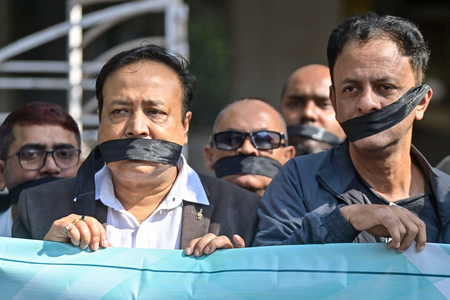
Dhaka, April 23 (IANS) Bangladesh’s newspapers must rediscover their voice — not as reflections of authority, but as instruments of accountability. During a national crisis, the press acts not just as an observer — it becomes the conscience of people, a report has highlighted.
Writing for Bangladeshi daily ‘The Asian Age’ earlier this week, Anwar A Khan, a 1971 Bangladesh Liberation War freedom fighter and columnist, stated that since August 5, 2024, serious allegations of human rights violations have cast a “long and troubling shadow” over Bangladesh, accompanied by an unsettling silence in the newspaper landscape. He argued that silence is not neutrality but abdication.
“The Constitution of Bangladesh, in its very spirit, enshrines fundamental rights that are neither ornamental nor optional. Article 11 proclaims that the Republic shall be a democracy in which fundamental human rights and freedoms are guaranteed. Article 39 explicitly secures freedom of thought and conscience and of speech. When these principles are perceived to be under strain, the press bears a solemn duty to question, to investigate, and to speak. To remain muted is to stand in quiet complicity,” Khan wrote.
“Equally alarming is the banning of the Awami League — historically the oldest, largest, and founding political force of the nation. Whether one aligns with its politics or not, the very act of proscribing a major political party strikes at the pluralistic foundation of democratic life. Article 37 of the Constitution guarantees the right to assemble and participate in political activity. To erode this right is to hollow out democracy itself,” he added.
Khan questioned the absence of editorials of moral clarity in Bangladesh’s newspapers and the lack of bold headlines that challenge authority when it strays from constitutional bounds.
“The press, often celebrated as the ‘fourth estate’, have colossally retreated into cautious ambiguity, offering tepid reportage where firm ethical conviction is required. This reluctance invites a dangerous precedent: that truth may be tempered, that injustice may be normalised, and that power may go unchallenged,” he noted.
Asserting that Bangladesh stands at a critical juncture, Khan said, “Its constitutional framework, hard-earned through sacrifice and struggle, demands vigilant guardianship. Newspapers, as custodians of public discourse, must reclaim their courage. They must ask difficult questions, present inconvenient facts, and provide space for principled debate. Anything less diminishes not only their own credibility but also the democratic fabric they are meant to uphold.”
–IANS
scor/as