
Badminton WC: Why was 29-30 enough to decide the set — the golden-point rule that dented India’s thriller

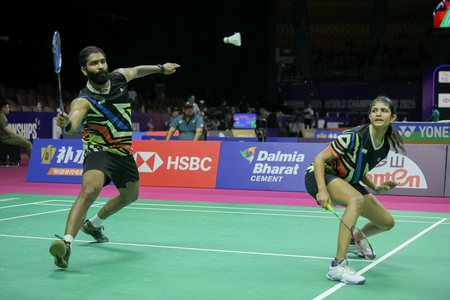
New Delhi, Aug 18 (IANS) A scoreline of 30-29 is not something badminton fans see every day, but it proved decisive for Ashith Surya and Amrutha Pramuthesh as their BWF World Championships debut turned into a 71-minute battle against Turkey’s Emre Sonmez and Yasemen Bektas at the Indira Gandhi Indoor Stadium in New Delhi on Tuesday.
The Indians had taken the opening game 21-16, but after being locked at 29-29 in the second, they lost the next rally and the game 30-29. The Turkish pair then held their nerve to win the decider 24-22 and seal the match.
For those watching the contest, the 29-30 scoreline raised an obvious question: How could Turkey win a badminton game without having a two-point advantage? The answer lies in the sport’s built-in limit.
Under the standard 21-point badminton scoring system, the first player or pair to reach 21 points wins a game. There is, however, one important condition: once the score reaches 20-20, the winner must establish a two-point cushion. That means a game can continue well beyond 21 points.
A score of 22-20 is enough. If the players remain level, the game can move to 23-23, 24-24, and beyond, with the winner needing to create that two-point gap. That is precisely what happened between Surya-Pramuthesh and Sonmez-Bektas.
Neither pair was able to pull two points clear as the second game entered its final stages. The score eventually reached 29-29, leaving the contest one rally away from its special cut-off point. There is a hard ceiling in the current scoring system at the World Championships. Once a game reaches 29-all, the requirement for a two-point margin disappears. The next rally becomes decisive. In other words, there is no 31-29 or 32-30.
The player or pair that wins the rally at 29-29 takes the game 30-29. That is what happened here on Tuesday. Sonmez and Bektas won the decisive rally, turning an exhausting second-game battle in their favour and levelling the match at one game apiece.
The Turkish pair therefore did not win because the two-point rule was ignored. They won because the rules stipulate that 30 is the maximum score in a game under the current system.
The Indians appeared to have the upper hand after winning the opening game 21-16, but the second game developed into an entirely different contest. Surya and Pramuthesh were unable to create the decisive separation they needed. The Turkish pair kept matching them point for point, with the game eventually reaching its dramatic conclusion at 29-29.
For the Indians, it was especially painful because they had opportunities to finish the game earlier. The inability to convert those chances meant that the contest was ultimately decided by one final rally. That one point changed the complexion of the match.
The deciding rally at 29-all is commonly described as a golden point because there is no further opportunity for the trailing side to respond. Whoever wins that single rally takes the game. It is effectively sudden death.
The system has produced some memorable badminton moments. One notable example came in the 2021 All England final, when Malaysia’s Lee Zii Jia won the opening game against Viktor Axelsen 30-29 before going on to win the deciding game 21-9 and claim the title.
The loss of the second game did not immediately end Surya and Pramuthesh’s hopes. The Indians pushed the Turkish pair through another tense game, but Sonmez and Bektas again held their nerve when the score tightened.
The decider also went beyond the usual winning threshold before Turkey finally prevailed 24-22. The result meant the Indian pair lost despite taking the first game and being involved in two fiercely contested games after that.
The scoring structure being introduced by the Badminton World Federation will change the point at which sudden death comes into play. Under the proposed 3×15 system, games are played to 15 points, with the scoring mechanism designed so that when the score reaches 14-all, the next point becomes decisive. If the score reaches 20-all after a game has extended beyond 14-all, the following rally decides the game, resulting in a 21-20 score.
That system is different from the one used in the World Championships in New Delhi. For Surya and Pramuthesh, the rules currently in force meant that 29-29 was the final fork in the road. One rally decided the second game, and losing it left the Indian debutants needing to win the third.
They came close again, but Turkey prevailed 24-22. The 30-29 score may look unusual, but it was not a scoring error or an exception made for the match. It was the consequence of badminton’s two-point rule meeting its maximum-score limit. At 29-all, there could be only one more point, and Turkey won it.
And in a match where the Indian pair had started with a 21-16 victory and fought all the way through a 71-minute thriller, that single rally ultimately separated the two sides.
–IANS
vi/bsk/