At Western Zonal Council, CM Patel highlights Gujarat’s ‘GOBARdhan’ success and cooperative federalism

Panaji, Sep 7 (IANS) Gujarat Chief Minister Bhupendra Patel on Monday highlighted the state’s experience with household biogas plants under the ‘GOBARdhan’ scheme at the 28th meeting of the Western Zonal Council in Goa, presenting it as a best practice in converting rural waste into clean energy and supporting organic farming.
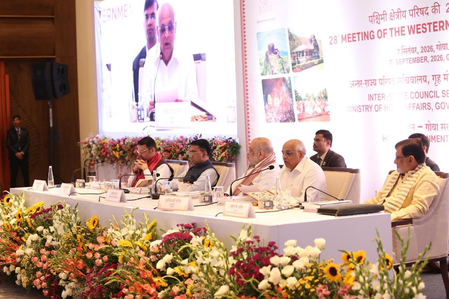
The meeting, chaired by Union Home and Cooperation Minister Amit Shah in Panaji, was attended by the chief ministers of Gujarat, Maharashtra and Goa, along with the Administrator of the Union Territory of Dadra and Nagar Haveli and Daman and Diu.
The Western Zonal Council comprises Gujarat, Maharashtra and Goa and the Union Territory.
Patel said Prime Minister Narendra Modi had adopted cooperative federalism as the guiding principle for the country’s development and described the Zonal Council as an important platform for states to work together on issues of common interest.
“With the continuous guidance of Union Home Minister Amit Shah, the Western Zonal Council has strengthened the tradition of mutual cooperation, coordination and dialogue,” Patel said, adding that the council was emerging as a result-oriented platform rather than merely an advisory body.
He said the meetings allowed participating states to share their strengths, resources, experiences and best practices to work towards common national objectives.
According to Patel, this approach was providing renewed strength to the states to contribute towards PM Modi’s vision of Viksit Bharat 2047.
The Chief Minister presented several initiatives undertaken by Gujarat, including the prompt availability of Emergency Response Support System (ERSS) 112 services, fast-track courts for speedy disposal of serious crimes such as sexual offences, arrangements for maternal and infant nutrition, and the expansion of the cooperative sector in rural areas.
The GOBARdhan scheme was presented as Gujarat’s best practice during the meeting.
Patel said the Central Government scheme seeks to convert waste into wealth while promoting better waste management, clean-energy kitchens, reduction in pollution, livelihood opportunities for women and the expansion of ODF Plus.
Under the household biogas plant model in Gujarat, 14,745 rural families have been covered, according to the state government.
The plants have resulted in annual savings of Rs 36.86 crore in fuel expenditure, while more than 12,800 metric tonnes of carbon emissions are being reduced annually.
The scheme has also generated 3.81 crore litres of bio-slurry annually, which the government said was helping promote organic farming and reduce dependence on chemical fertilisers.
Patel also said the Central Government, under PM Modi’s leadership, had approved the Rs 23,700-crore GOBARdhan scheme to promote Compressed Biogas (CBG) production across the country.
Gujarat, he said, was committed to advancing the objective of turning waste into wealth through the GOBARdhan scheme at household, industrial and community levels under the CBG Mission.
The meeting was held as the Centre continues to position the Zonal Councils as forums for structured dialogue between states and between states and the Centre.
The Union Home Ministry has said the councils are intended to facilitate cooperation and help resolve issues involving two or more states or the Centre and states.
Minister Rushikesh Patel; Gujarat Chief Secretary M. K. Das; Principal Secretary to the Chief Minister, Sanjeev Kumar; and other officials accompanied the Chief Minister at the meeting.
The 28th Western Zonal Council meeting was chaired by HM Shah as part of the council’s regular institutional mechanism for cooperation among the western states and the Union Territory.
–IANS
mys/uk