Advocates across India urge SC to take suo motu cognisance of Rahul Gandhi’s protest near PM residence

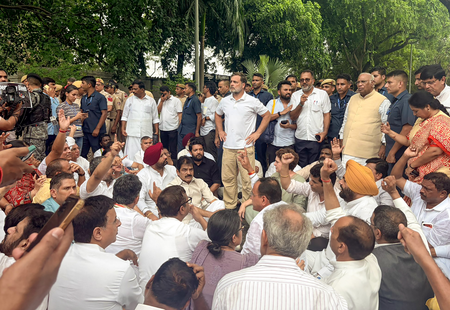
New Delhi, July 24 (IANS) A group of advocates from across the country has written to Chief Justice of India (CJI) Surya Kant, urging the Supreme Court to take suo motu cognisance of the July 21 sit-in protest led by Leader of Opposition Rahul Gandhi and other Opposition leaders near Prime Minister Narendra Modi’s official residence at 7, Lok Kalyan Marg.
The representation, signed by advocates from multiple High Courts and coordinated by advocate Sanket Gupta, urged the apex court to order a fact-finding inquiry into the protest and lay down binding guidelines governing demonstrations in the vicinity of high-security installations.
The advocates contended that the protest, held outside the Prime Minister’s residence, raised issues extending beyond ordinary public assembly and touched upon concerns of national security and constitutional governance.
According to the representation, Rahul Gandhi, Congress president Mallikarjun Kharge, Priyanka Gandhi Vadra, Samajwadi Party chief Akhilesh Yadav, other MPs, and the Chief Ministers of Kerala and Karnataka held a sit-in protest in the immediate vicinity of the Prime Minister’s residence without prior information or permission.
The representation said the area was “among the most security-sensitive locations in the National Capital” and that any unregulated gathering there carried security implications beyond those ordinarily associated with public protests.
It alleged that senior police officers repeatedly requested the protesters to disperse, informing them that the site was a high-security zone, but the assembly continued despite those appeals.
The advocates further claimed that Union Minister of State in the Prime Minister’s Office Jitendra Singh personally met Rahul Gandhi and urged him to end the protest after assuring that the government was willing to discuss the issue in Parliament, but the demonstration continued for several hours.
Referring to Rahul Gandhi’s social media post calling upon citizens to join the dharna, the representation alleged that inviting members of the public to gather near the Prime Minister’s residence carried “serious and foreseeable security implications” because of the unpredictable size and composition of any responding crowd.
According to the advocates, the Delhi Police eventually removed Rahul Gandhi and other MPs from the site after nearly three hours. “It is a matter of grave concern that a Constitutional functionary such as the Leader of Opposition himself placed the police in a position where such physical removal became necessary,” the representation stated, adding that any untoward incident during the standoff could have had “severe” consequences given the sensitivity of the location.
The advocates stressed that while the right to protest is constitutionally protected, it remains subject to reasonable restrictions in the interests of public order and national security.
“It is submitted that Article 19(1)(b) of the Constitution guarantees the right to assemble peaceably and without arms, but this right is expressly subject to reasonable restrictions under Article 19(3) in the interests of public order and the sovereignty and integrity of India,” the representation said.
The representation also argued that permitting such protests at high-security installations without scrutiny could set an undesirable precedent. “It is submitted that if this becomes a regular practice, it would pose a serious and continuing threat to the internal security architecture of the country,” it said.
“The Constitution makes no distinction between the ordinary citizen and the highest office-holder — all are equally bound by law, and the right to protest guaranteed by the Constitution is, and must remain, subject to reasonable limitations, including the requirement of prior permission in sensitive areas,” the representation added.
Seeking judicial intervention, the advocates urged the Supreme Court to take suo motu cognisance of the incident, direct an appropriate fact-finding inquiry, and frame uniform, prospective guidelines regulating protests in the immediate vicinity of high-security installations.
They said such guidelines should apply equally to all political parties and formations and balance the constitutional right to protest with legitimate security imperatives.
–IANS
pds/dpb