
New Delhi, Nov 5 (IANS) Pakistan and Turkey have come under scrutiny over their religious policies, with American expert Michael Rubin questioning their remarks on India’s domestic affairs despite allegations of religious discrimination and intolerance within their own borders, a report has stated.
In his latest article in The Sunday Guardian, Rubin also highlighted mounting discrimination against Hindus and Christians in Pakistan, incidents of communal violence and the reported misuse of blasphemy laws. He argued that countries facing criticism over religious tolerance within their own borders should also be scrutinised when commenting on the religious and social affairs of other nations.
Drawing attention to the rhetoric emerging from Turkey’s state media, which he described as even more virulent, Rubin cited a series of articles targeting India. He referred to an April 2025 article by Ibrahim Karagul, editor of Yeni Safak, described as Turkish President Recep Tayyip Erdogan’s preferred newspaper and the unofficial mouthpiece of his regime. Karagul wrote, “If China and Turkey stand with Pakistan… India will be torn to pieces,” adding, “The Mughal Empire, the Seljuks, the Ottomans, all will join this war!”
Rubin further cited a May 8 editorial in the same newspaper by Pakistani columnist Furqan Hamid, head of Turkish state television’s Urdu service, which claimed that India “has become unlivable for minorities.” The next day, Sabah columnist Hilal Kaplan alleged that “An unnamed genocide of Muslims has been under way in India for some time….”
“The irony, of course, is that Muslims enjoy far greater rights in India and Israel than in countries ruled by fellow Muslims. In Freedom House’s latest annual rankings, Israel scores three points above Senegal and Albania, the high-ranking Muslim majority states. Freedom House analysts have historically been unfairly antagonistic to India, but even Freedom House acknowledges that India is far more tolerant and democratic than Indonesia, any Arab country, let alone Pakistan and Turkey, which score alongside Algeria and Iraq,” said Rubin, Director of Policy Analysis at the Middle East Forum in Washington.
Rubin recalled that on April 16, 2025, Pakistan’s Army Chief Asim Munir had declared, “Our forefathers thought that we are different from Hindus in every possible aspect of life… We are two nations, we are not one nation.”
The expert said that Pakistan’s earlier rhetoric largely revolved around the Indian Union Territory of Jammu & Kashmir, but its recent alignment with Turkey, which has increasingly adopted an Islamist-oriented foreign policy, points to ambitions extending beyond the region, with both countries signalling broader sectarian objectives.
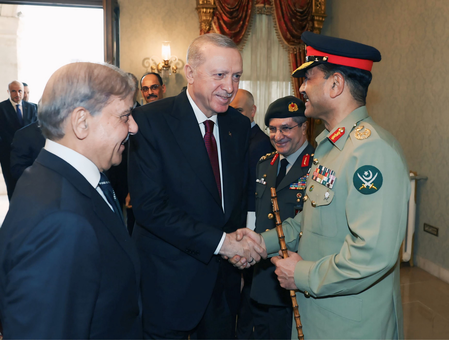
Referring to provocative remarks made by Munir and Erdogan against India, Rubin said that both Pakistan and Turkey are the antithesis of tolerance.
“When Pakistan gained independence, it had large Christian and Hindu minorities and even considered major Christian and Hindu festivals and national holidays. Today, many Christians and Hindus have fled, as state-incited pogroms and maliciously applied blasphemy laws take their toll. And, while Pakistan supports the Khalistan movement in India, it fails to mention its eradication of Sikh communities in Pakistani Punjab,” he mentioned.
–IANS
scor/as