UNCTAD head Grynspan leads race for UN secretary-general; breakthrough eludes UAE’s Nusseibeh

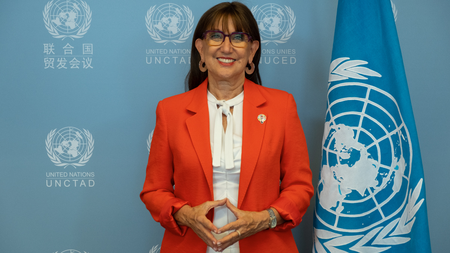
United Nations, Oct 31 (IANS) Rebecca Grynspan, the Costa Rican head of UNCTAD, made slight progress in the race to be the next secretary-general in an anonymous straw poll of Security Council members, while the United Arab Emirates’ Lana Nusseibeh failed to make a breakthrough in her debut.
Grynspan received 11 positive votes on Friday, up two from the last poll, and narrowed the negative votes to four, down one.
However, it was unclear whether any of the negative votes came from a permanent member, which would doom her chances, as the latest poll, the seventh, did not colour-code ballots to distinguish permanent members’ votes as the last one did.
Grynspan received two negative votes from permanent members in the sixth poll two weeks ago.
Keeping her grip as the front-runner, she has led six of the seven polls.
With the clock ticking on a two-month deadline to have a successor in place when Antonio Guterres’ term runs out at the year’s end, Greece’s Permanent Representative Aglaia Balta, the president of the Security Council for October who oversaw the straw poll, gave the assurance that the election would be done on time.
She said, “The Security Council plans to make its recommendation to the General Assembly in a timely manner so that the appointment by the Assembly allows the newly elected Secretary-General sufficient time to prepare for the job”.
The entry of Nusseibeh, UAE’s minister of state for foreign affairs, in the race was seen as a test of whether she can break the deadlock that marked the first six rounds of straw polls.
After the UAE nominated her last week, Friday’s round reverted to the initial practice of not colour-coding the ballots.
Nusseibeh received seven positive, six negative, and two neutral votes, putting her in fourth place behind Rafael Grossi, the Argentine heading the International Atomic Energy Agency, and Carolyn Rodrigues-Birkett, former foreign minister of Guyana.
In straw polls, members vote “encourage”, interpreted as positive, “discourage” as negative, and “no opinion” as neutral.
In keeping with the ground rules, Balta did not announce the results, but they were leaked to PassBlue and 1for8Billion, which cover the UN in-depth.
Latvia, which takes over the election process when it assumes the presidency next month, will face pressure to speed it up.
The candidate who wins ten votes without a veto from a permanent member will be recommended to the General Assembly, which routinely rubber stamps the Council recommendation that usually emerges unanimously in the final stage.
That effectively makes the winner the consensus candidate of the five permanent members.
At the current stage, the Security Council members negotiate behind closed doors to narrow their differences and agree on a candidate.
Grynspan losing a negative vote, and Grossi trimming his “discourage” ballots by two in this round to four, and increasing the positives by one to nine, shows some movement in the discussions at the Security Council.
In the last poll, both of them and Birkett-Rodrigues received two negative votes each from permanent members, and it was unclear if that had changed this time without ballots that distinguish theirs.
After Friday’s straw poll, Grynspan posted on X, “We face pivotal moments that require a united and modern United Nations. I remain committed to listening to all voices, pursuing necessary reform, and delivering on our shared mandate for peace and security”.
After nine men heading the UN for all its 80 years, the international sentiment is strong for electing a woman as secretaries-general.
Latin America, including the Caribbean, has said the next UN head should be from their region since it is 35 years since anyone from there held the office after Javier Perez de Cuellar ended his term in 1991.
Representatives of the Community of Latin American and Caribbean States (CELAC) jointly met the media outside the Security Chamber on Tuesday to stake their region’s claim.
With the region’s diplomats lined up beside her, Uruguay’s Permanent Representative Laura Dupuy Lasserre said, “The time has come for a national of Latin America and the Caribbean to assume the responsibility of holding the position of Secretary-General of the United Nations in accordance with the principle of equitable geographical balance and with the strengthening of diversity in the leadership of the organisation”.
The region has nominated “highly competitive candidates who possess the qualities required to lead the organisation and who have successfully withstood an exhaustive public scrutiny”, she said, adding that they have consistently received the strongest support in the straw polls.
Except for one where Olaru Otunnu, a former under-secretary-general and Uganda’s foreign minister, came third, the top three candidates in the straw polls have been from the region.
On Friday, Birkett polled eight positive, six negative and one neutral vote, Otunnu received 11 negative votes and four positives; Maria Fernanda Espinosa, a former president of the General Assembly and Ecuador’s foreign minister, got ten negatives and two positives; and Ivonne A-Baki, a former Ecuadorian ambassador to the US, recorded 14 negatives and one positive.
–IANS
al/rs