
Arunachal CM Khandu calls for roadmap to boost yak conservation, herders’ livelihoods

Itanagar, Oct 17 (IANS) Arunachal Pradesh Chief Minister Pema Khandu on Saturday called for a comprehensive roadmap to strengthen yak conservation, improve the livelihoods of yak herders and harness the economic potential of yak-based products, stressing the need for focused policy support from both the state and Central governments for traditional yak-rearing communities in the Himalayan region.
The yak is a long-haired species of domesticated cattle native to the Himalayan region, the Tibetan Plateau, Tajikistan and the Pamir Mountains, with its distribution extending northwards to Mongolia and Siberia. It is descended from the wild yak.
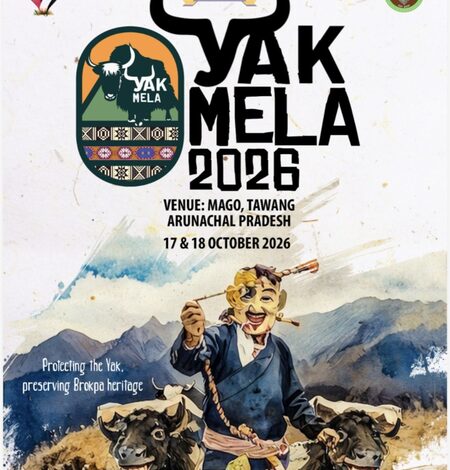
Addressing the Yak Economy Summit 2026 and Yak Mela at Mago in Tawang district, the Chief Minister said yak rearing was not merely a livelihood but also an important part of the social, cultural and strategic landscape of the Himalayan belt, extending from Jammu and Kashmir to Arunachal Pradesh.
“From the perspective of national security, it is our duty to support our Brokpa communities and yak herders through appropriate policy interventions,” he added, underlining the importance of strengthening pastoral communities living in remote and strategically significant areas.
Khandu said that yak associations had now been formed in Arunachal Pradesh, Sikkim, Ladakh and Himachal Pradesh, bringing these regional bodies together under the Yak Federation of India.
He recalled participating virtually in the Federation’s first programme in Ladakh, noting that the deliberations at Mago were significant not just for Arunachal Pradesh but for the entire country.
The Chief Minister announced that a follow-up meeting would be convened in February, within the next three months, to review progress and share a roadmap for taking the initiative forward.
The roadmap, he said, would identify the policy interventions required from the state government and the Union government to ease the lives of yak herders and improve their income.
Emphasising the need for a clear understanding of the sector, Khandu added that comprehensive mapping of yak populations, herders and their seasonal movements must be undertaken before planning could progress.
Mapping of both summer and winter grazing camps would be essential for developing appropriate infrastructure and ensuring the sustainable management of yak herds.
The state’s yak economy, he noted, could not be strengthened without organising herders into cooperatives.
He called for the establishment of the Arunachal Pradesh Yak Herders and Products Development Cooperative Society, stressing that a cooperative framework would help herders pool resources, improve bargaining power, access markets and develop viable businesses around yak products.
The proposed roadmap is expected to bring together the Army, the ICAR-National Research Centre on Yak (ICAR-NRCY), relevant government departments and other stakeholders to develop a coordinated and sustainable approach to yak rearing and pastoral livelihoods.
Khandu also called for capacity building and the adoption of scientific yak-rearing practices, including the semi-intensive model developed by ICAR-NRCY.
He stressed the need to develop basic amenities for Brokpa communities at summer and winter satellite stations, while ensuring that traditional grazing practices and livelihoods are protected.
A Brokpa-friendly grazing tax regime, particularly in winter grazing grounds, was among the measures highlighted for consideration.
Highlighting the commercial potential of yak products, the Chief Minister said the quality and taste of yak dairy products could help them establish a strong presence in the market.
He expressed confidence that yak cheese and yak ghee, if developed and marketed effectively, could compete with established brands.
The Chief Minister called for stronger dairy development and value chains for yak milk products and fibre, along with the involvement of investors and entrepreneurs to improve processing, marketing and market access.
Yak-based livelihoods, he said, could extend beyond animal husbandry to include cottage stays, guiding services and the sale of local crafts.
The summit also highlighted the need to explore education-related proposals for yak herders under the National Livelihood Mission framework, alongside targeted support for Brokpa communities.
The possibility of extending special-category recognition to Brokpas, along with the Puroik community, was also raised for consideration.
–IANS
sc/khz