
Washington, Sep 28 (IANS) Canada has warned that security threats facing its Arctic region have “shifted significantly” as Russia’s war in Ukraine, strategic competition and questions about sovereignty reshape the geopolitics of the far north.
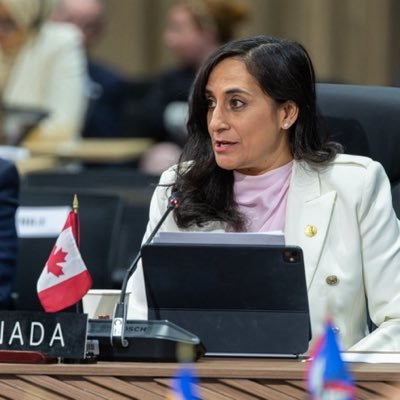
Foreign Affairs Minister Anita Anand said Canada and the United States continued to coordinate closely on Arctic security despite broader political and trade tensions between the neighbouring countries.
Indian origin Anand told Global News that Russia’s invasion of Ukraine had changed how governments assessed security in Europe and the Arctic.
She attended a meeting of Arctic nations convened last week by US Secretary of State Marco Rubio.
The participants “had a frank discussion about the collective need to work together on Arctic security”, Anand said.
“So the United States is very much at the table in this conversation,” she said.
“And one of the ongoing dialogues that Secretary Rubio and I have had specifically … is in fact how can Canada and the United States ensure that our shared interests in the Arctic are advocated, are worked on within the confines of multilateral organizations including NATO.”
Canada and the United States share responsibility for monitoring and defending the northern approaches to North America. But the relationship has come under strain over tariffs and other political disputes.
Anand’s remarks indicated that Ottawa was seeking to separate those differences from practical cooperation over Arctic defence and sovereignty.
She also called for NATO to give greater attention to threats in the north instead of concentrating primarily on its eastern European members.
“So while Canada has Operation Reassurance on the Eastern flank, we cannot forget that NATO, the North Atlantic Treaty Organization, should have a view that is based on a strategic assessment of the North and the Arctic, in order to ensure that we are well defended and protected in terms of the Arctic, not only on the Eastern flank,” Anand said.
Prime Minister Mark Carney’s government has announced plans to increase defence spending and strengthen Canada’s military presence in the region.
The measures include a contract with German shipbuilder TKMS for a fleet of as many as 12 submarines. The Canadian government has not completed its decision on the purchase of new fighter aircraft.
Ottawa is also expanding its diplomatic footprint in the region. Canada has opened a consulate in Nuuk, Greenland, and plans to establish another in Anchorage, Alaska.
The security coordination comes as public attitudes towards the United States are changing in northern Canada.
A poll conducted for the Observatoire de la politique et la sécurité de l’Arctique found that 48 per cent of respondents regarded the United States as the greatest threat facing the region.
Russia was identified by 30 per cent of respondents, while 12 per cent selected China.
The survey covered residents of Nunavut, the Northwest Territories, Yukon and Nunavik.
The findings expose a gap between Canada’s strategic dependence on the United States and the increasingly uneasy public perception of its southern neighbour.
Canada and the United States nevertheless remain partners in the North American Aerospace Defence Command, or NORAD. The two countries use the joint command to monitor aircraft, missiles and other threats approaching North America.
Arctic is becoming more strategically important as retreating ice makes shipping routes and natural resources more accessible. Russia has a substantial military presence in the region, while China describes itself as a “near-Arctic state” and has sought a larger economic and scientific role.
India has maintained a research presence in the Arctic and released an Arctic policy in 2022. New Delhi’s interests include climate science, polar research, emerging shipping routes and the effect of Arctic changes on the Indian monsoon and the Himalayan environment.
–IANS
lkj/rs