
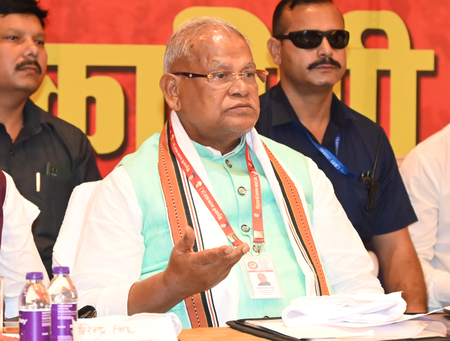
Patna, Sep 26 (IANS) Union MSME Minister Jitan Ram Manjhi on Saturday targeted opposition leaders over the ongoing political debate surrounding reported differences of opinion within the Election Commission of India, including those concerning Chief Election Commissioner Gyanesh Kumar.
He said those attempting to politicise differences of opinion within an institution were inexperienced, arguing that differing views can arise during deliberations in various constitutional and governmental bodies.
Manjhi cited Cabinet meetings, Election Commission proceedings, and deliberations involving judges as examples where different views may emerge.
His remarks come amid controversy over reports that Election Commissioners Sukhbir Singh Sandhu and Vivek Joshi had raised objections on several matters over 10 months. The Election Commission has said that individual observations and differing views are part of its normal internal deliberative process and maintained that its final decisions were taken unanimously.
Manjhi said a difference of opinion does not necessarily mean that every individual’s view will prevail, adding that the institution’s prescribed decision‑making process ultimately determines the outcome.
Separately, Manjhi wrote a letter to Lok Sabha Speaker Om Birla seeking adequate speaking time for Members of Parliament belonging to the Scheduled Castes (SC) and Scheduled Tribes (ST) during parliamentary discussions on important Bills.
BJP MP Gajendra Singh Patel, who represents the Khargone Lok Sabha constituency in Madhya Pradesh, raised the issue during an NDA MPs Group Dialogue Meeting held at Manjhi’s residence on August 5. Manjhi subsequently raised the matter with the Lok Sabha Speaker in a letter dated September 16.
Speaking to journalists at his residence in Gaya on Saturday, Manjhi explained how the NDA parliamentary group functioned during the 2024–2029 term. He said groups of around 14–15 MPs meet under a minister’s leadership, either at the beginning or end of a parliamentary session, to discuss issues of concern.
“MPs raise all kinds of issues and concerns they feel are important during these meetings. It is my practice that whenever an MP speaks, voices a grievance, or offers a suggestion, I write to the relevant ministry. I inform them that the MP has raised these points and request that necessary action be taken,” Manjhi said.
He added that Patel had specifically raised concerns that SC and ST MPs were not getting sufficient opportunities to speak during discussions on important Bills.
“The issue raised was that MPs from Dalit and Mahadalit communities get fewer opportunities to speak. I wrote to the Speaker about this; although, strictly speaking, I should have written to the Minister of Parliamentary Affairs, I wrote directly to the Speaker. There is no political angle to this,” Manjhi said.
He stressed that the matter was not personal but related to concerns raised by Members of Parliament.
“This is not a personal matter; rather, it is an issue raised by Members of Parliament, and since I am the leader of the group, I need to convey these concerns to the concerned ministry. That is why I wrote a letter to the Speaker regarding this matter,” he said.
–IANS
ajk/dan