More insidious than Mao’s chaos: Chinese President Xi’s Unity Law exposes racial chauvinism

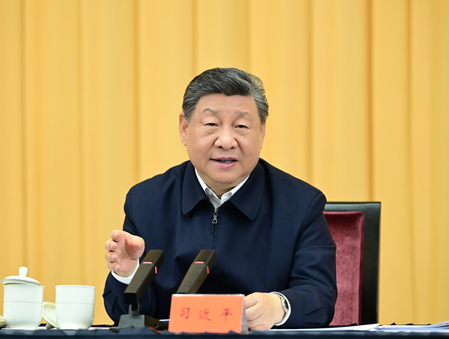
Brussels, Sep 19 (IANS) Chinese President Xi Jinping’s Unity Law lays bare the racial chauvinism at the foundation of his rule. By dismantling the safeguards of the former Chinese leader Mao Zedong’s era and legally entrenching Han dominance, Xi has fashioned a system arguably “more insidious than Mao’s chaos”, a report has stated.
Mao relied on violence to destroy; Xi uses the law to erase. In doing so, Xi has emerged as the “worst recent Chinese leader” — not simply for resurrecting Maoist authoritarianism, but for reshaping it into a durable, racialised autocracy, Khedroob Thondup, the nephew of the Dalai Lama, wrote in ‘European Times’, earlier this week.
“When historians weigh the legacies of China’s rulers, Mao Zedong inevitably looms as the architect of both revolutionary triumph and catastrophic suffering. Yet in the decades after Mao, China’s leadership sought to avoid repeating his excesses by building collective governance, term limits, and a cautious balance of power. Xi Jinping has not only dismantled those safeguards — he has introduced new instruments of authoritarianism that make him arguably the worst Chinese leader since Mao,” Thondup detailed.
He stressed that Xi’s “so‑called Unity Law” is a clear manifestation of this regression, revealing the “racial chauvinism and political absolutism” underpinning the Chinese President’s rule.
“After Mao’s death, Deng Xiaoping and his successors tried to stabilise China by embedding collective leadership and limiting personal power. Jiang Zemin and Hu Jintao were cautious technocrats, presiding over economic growth without dismantling institutional checks. Xi Jinping reversed this trajectory. Term limits were abolished in 2018, enabling indefinite rule. Leadership purges sidelined rivals and stacked the Politburo with loyalists. Centralisation of authority shifted decision‑making from collective bodies to Xi himself,” Thondup added.
He further noted that the regression is deliberate, with the system being re-engineered to mirror Mao’s one-man dominance while leveraging modern surveillance and propaganda tools.
According to Thondup, although Xi’s Unity Law is portrayed as a means of promoting national unity, it effectively gives Beijing a legal weapon to target minority communities inside China and abroad, including Tibetans, Uyghurs and Mongols.
He said that by criminalising expressions of cultural autonomy as “separatism”, the law pressurises overseas communities to conform to Beijing’s narrative, extending the Chinese authorities’ authoritarian reach beyond borders.
“By elevating Han identity as the standard of ‘unity,’ the law delegitimizes minority cultures, echoing Mao’s campaigns but with sharper racial undertones. This is not mere authoritarianism; it is racialised authoritarianism. Xi has fused nationalism with ethnic hierarchy, weaponizing law to erase diversity. Xi’s distinction lies in his ability to cloak repression in legality. Mao’s violence was chaotic and visible; Xi’s repression is codified, bureaucratic, and harder to challenge internationally,” Thondup wrote.
“The Unity Law intensifies surveillance, detention, and cultural erasure. Tibetans, Uyghurs, and others abroad face intimidation, shrinking the space for exile activism. Ironically, Xi’s law has raised global awareness of China’s racial authoritarianism, uniting critics across democracies,” he highlighted.
–IANS
scor/as