
India, Nepal discuss easing trade barriers, strengthening customs and transit connectivity

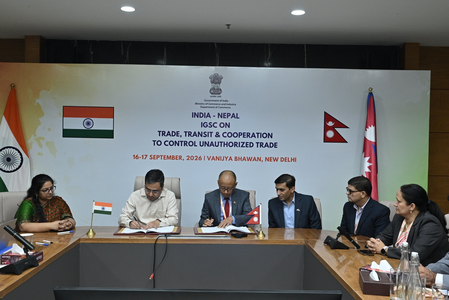
New Delhi, Sep 18 (IANS) India and Nepal reviewed a wide range of trade and transit-related issues, including market access, customs facilitation, border infrastructure and connectivity, during a two-day inter-governmental meeting here, an official statement said on Friday.
According to the Ministry of Commerce & Industry, the India-Nepal Inter-Governmental Sub-Committee (IGSC) on Trade, Transit and Cooperation to Control Unauthorised Trade was held here.
The Indian delegation was led by Joint Secretary in the Department of Commerce Ujjwal Kumar Ghosh, while the Nepali side was headed by Joint Secretary in the Ministry of Industry, Commerce and Supplies Buddha Bahadur Gurung.
The IGSC is a bilateral institutional mechanism for examining trade-related issues and facilitating trade and transit between the two countries, the ministry said.
During the meeting, the two sides discussed measures to facilitate greater market access for products from India and Nepal, including agricultural and dairy products, food items, pharmaceuticals, medical devices and AYUSH products.
Issues relating to standards, food safety, plant quarantine and phytosanitary requirements were also reviewed.
In addition, two sides discussed strengthening Customs cooperation and trade facilitation through measures such as pre-arrival exchange of information, electronic verification of Certificates of Origin, Customs automation and digitalisation, according to the ministry.
The discussions sought to facilitate legitimate trade while strengthening compliance mechanisms and preventing misuse of preferential trade arrangements, the ministry said.
Transit and connectivity also figured prominently in the discussions, with both sides reviewing rail and road connectivity, freight movement, Integrated Check Posts and land-port infrastructure.
The two countries also discussed better utilisation of existing infrastructure and measures to address operational bottlenecks affecting bilateral and transit trade.
Moreover, they welcomed continued cooperation in standards, food safety, plant quarantine and conformity assessment, including institutional cooperation and capacity-building initiatives.
They also stressed the need for continued coordination among relevant agencies to facilitate legitimate cross-border trade and address unauthorised trade and commercial fraud.
–IANS
ag/