
Bihar flood: Samrat Choudhary conducts aerial survey as Son barrage discharge rises

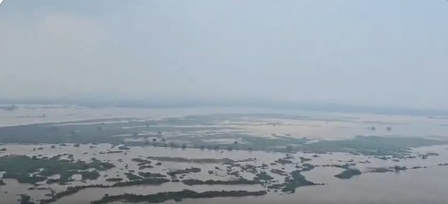
Patna, Sep 4 (IANS) Concerns over the flood situation in Bihar intensified on Friday as water levels in several rivers continued to rise and substantial quantities of water were released from major barrages.
Chief Minister Samrat Choudhary conducted an aerial survey of flood-affected areas and reviewed the ongoing relief and rescue operations.
Taking to social media platform X, Chief Minister Choudhary said he had assessed the flood-affected areas through an aerial survey and reviewed the relief and rescue measures being undertaken by the administration.
He directed officials to take swift and effective action to ensure timely assistance to people in affected areas, minimise their difficulties, and protect lives and property.
According to Water Resources Department data available up to 2 p.m. on Friday, the Son, Kosi and Gandak barrages were releasing large quantities of water.
The highest discharge was recorded at the Son Barrage in Indrapuri, where the flow continued to show an upward trend.
The discharge from the Son Barrage increased steadily over a three-hour period. The discharge increased by 43,741 cusecs between 11 a.m. and 2 p.m. The department has listed the design discharge capacity of the Son Barrage at 14.58 lakh cusecs.
The rising discharge has prompted increased attention to the water level of the Son River and conditions in downstream and adjoining areas, particularly villages and low-lying regions.
The discharge from the Kosi Barrage at Birpur remained comparatively stable during the same period.
At 11 a.m. on Friday, the discharge was recorded at 2,02,310 cusecs. It declined to 1,94,100 cusecs at noon and stood at 1,91,175 cusecs at both 1 p.m. and 2 p.m.
The Water Resources Department described the trend at the Kosi Barrage as “steady”, indicating that no significant increase in discharge had been recorded during the preceding hours.
However, given the Kosi’s sensitivity to changes in water levels, officials continue to monitor the river and the condition of its embankments closely.
At the Gandak Barrage in Valmikinagar, the discharge remained unchanged at 1,42,800 cusecs from 11 a.m. to 2 p.m.
The department has also categorised the trend there as “steady”.
The design discharge capacity of the Gandak Barrage is 8.50 lakh cusecs.
With flood and waterlogging conditions already affecting areas along the Gandak, officials are maintaining a close watch over downstream areas.
Any sudden change in discharge could further affect residents living along the river.
As of 2 p.m. on Friday, the Son Barrage was releasing the highest volume of water among the three major barrages, at around 5.18 lakh cusecs, followed by the Kosi at 1.91 lakh cusecs and the Gandak at 1.42 lakh cusecs.
While the discharge trends at the Kosi and Gandak barrages remained steady, the rising trend at the Son Barrage has emerged as a key concern for the administration.
The Water Resources Department has clarified that the trend is assessed on the basis of data from the preceding two hours and that discharge figures can change continuously.
With several parts of Bihar already facing rising river levels and flood-related problems, the administration has stepped up monitoring, particularly in villages and low-lying areas along the Son and other rivers.
Residents in vulnerable areas have been advised to remain alert and follow warnings and advisories issued by the local administration as officials continue to monitor river levels and barrage discharges.
–IANS
ajk/khz