
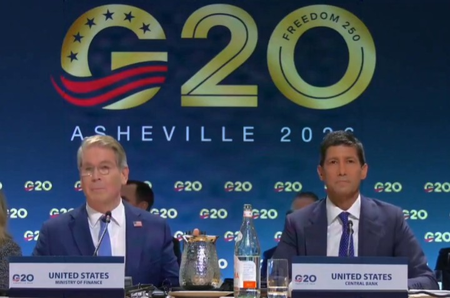
Asheville, Sep 1 (IANS) The Trump administration has used a meeting of G20 finance ministers in Asheville to press for stronger economic growth, fairer trade and regulatory reform, while warning that Iran’s closure of the Strait of Hormuz poses a risk to the global economy and energy security.
Erin Browne, US Treasury Under Secretary for International Affairs, said in a readout of Monday’s sessions that the meeting began with discussions on current economic developments and global growth.
“The Trump administration is laser focused on promoting a strong economy, both in America as well as globally,” Browne said. “And the G20 is a critical forum for addressing shared challenges and opportunities in the global economy.”
Treasury Secretary Scott Bessent opened the discussions by pointing to Asheville’s recovery from Hurricane Helene. The disaster forced families from their homes, inundated roads and destroyed businesses across western North Carolina.
“Today, Asheville reminds us what renewal looks like. It’s the comeback city,” Browne said.
The administration presented stronger growth as the foundation of its domestic economic programme and its agenda for the G20. Federal Reserve Chairman Kevin Warsh told the plenary session that “secular stagnation is over”, according to the readout.
Several G20 participants outlined their own efforts to promote growth. Some countries, including those in Europe, spoke about streamlining regulations to strengthen their economies.
Iran’s closure of the Strait of Hormuz also figured in the talks, with several countries raising concerns about its effect on the world economy.
The administration is focused on reopening the waterway, seeking a diplomatic outcome that denies Iran a pathway to a nuclear weapon and protecting global energy security, Browne said.
“It remains our ultimate objective to ensure that Iran never acquires a nuclear weapon,” she said, adding that achieving that goal would reduce long-term economic and market volatility.
Trade tensions and global imbalances were another major part of the discussions. The United States said it would use a separate G20 session to argue against what it considers unfair trading practices.
“We are no longer tolerating other countries’ unfair trading practices,” Browne said.
The Trump administration is using reciprocal and sectoral tariffs to make America’s trade relationships “more fair and more balanced”, she said. Those measures have been paired with tax incentives for investment, increased energy production and spending restraint to strengthen US production and national savings.
Bessent also sought to reassure partners about the administration’s foreign economic approach.
“America first does not mean America alone,” Browne said, recounting the Treasury Secretary’s message. “It means stronger partnerships built on a stronger America.”
The United States also brought private-sector executives into the G20 discussions to speak directly with senior economic and financial policymakers. The talks examined barriers to investment, innovation and productivity.
“The private sector doesn’t just participate in growth, it creates it,” Browne said.
Executives discussed the use of artificial intelligence in manufacturing and healthcare, as well as innovation in digital assets. They identified competitive tax systems, business-friendly regulations, lower operating costs and a skilled workforce as important conditions for growth.
The meeting also examined the effects of regulation on smaller US banks. The administration argued that tighter rules imposed after the global financial crisis had reduced the number of community and small banks without preventing three major American bank failures in 2023.
–IANS
lkj/rs