
Can question govt but can’t switch Parliament off: Rijiju berates Opposition over Monsoon Session washout

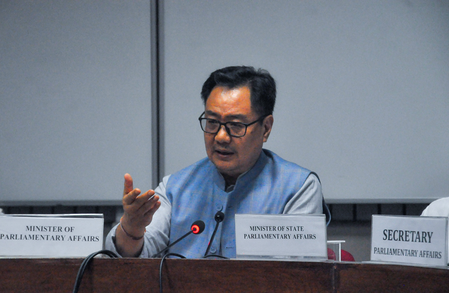
New Delhi, Aug 25 (IANS) Union Parliamentary Affairs Minister Kiren Rijiju on Tuesday hit out at the Opposition over repeated disruptions in Parliament during the Monsoon Session, asserting that while the Constitution gives them the right to question the government, it does not give them the power to disrupt proceedings repeatedly when their political demands are not accepted.
In an opinion article published in The Indian Express, Rijiju said that the Parliament belongs to the people of India and not to political parties. He highlighted several instances in which the government engaged with the Opposition on key issues and legislation, while accusing Opposition leaders of rejecting opportunities for structured debate and then blamed the government for reduced functioning of the House.
Rijiju referred to Monsoon Session figures, stated that the Lok Sabha functioned for only 15 per cent of its scheduled time, while the Rajya Sabha functioned for 33 per cent. He further pointed out that Question Hour operated for barely one per cent of its allotted time in the Lok Sabha and 12 per cent in the Rajya Sabha.
“The Opposition’s arithmetic is therefore deeply cynical: First ensure that Parliament cannot function, and then use the resulting loss of time as evidence against the government,” Rijiju said.
He argued that the Opposition has constitutional rights to hold the government accountable but cannot use disruption as a substitute for parliamentary debate.
“The Constitution gives the Opposition every right to question, criticise, protest, move amendments and vote against the government. It does not give the Opposition a remote control with which it may switch Parliament off whenever its political demands are not accepted,” Rijiju said.
He further claimed that the government had listened to Opposition concerns, negotiated on legislation, amended provisions and accommodated legitimate demands. However, he said the government would not surrender the people’s mandate to an Opposition that, according to him, paralyses Parliament and then uses the resulting disruption as evidence of authoritarianism.
The Union Parliamentary Affairs Minister also referred to the Opposition’s demand for a discussion on the police action against protesters at Jantar Mantar. According to Rijiju, Union Home Minister Amit Shah had agreed to the demand and had even offered a specific time frame for the debate.
However, he claimed that Congress leader and Leader of Opposition in the Lok Sabha Rahul Gandhi rejected the offer.
“The Leader of the Opposition, Rahul Gandhi, rejected the offer, declaring that the Opposition was not interested in the Home Minister’s ‘lecture’. A leader genuinely denied a debate seizes a 24-hour offer. He does not dismiss it as a lecture. One cannot refuse a full parliamentary discussion and then complain that Parliament has been silenced,” he said.
Rijiju also sought to question Gandhi’s parliamentary record, saying the contradiction becomes more significant when his participation in the 17th Lok Sabha is considered. He claimed that Gandhi recorded 51 per cent attendance, participated in eight debates against a national average of 46.7, asked 99 questions against an average of 210 and did not introduce any Private Member’s Bill.
“Yet he now declares that the government has ‘destroyed our democracy’. He goes to the UK, Germany and the US and complains about the lack of democracy in India. But he doesn’t have the gall to attend Parliament and seek accountability. Neither he nor the Congress party are defenders of democracy. They excel in political theatre bordering on parody,” Rijiju said.
The Union Minister also rejected the Opposition’s allegation that the government refuses to listen, arguing that the parliamentary record tells a different story. He cited the Foreign Contribution (Regulation) Amendment Bill as an example, saying that after opposition concerns were raised, the legislation was referred to a Joint Parliamentary Committee.
However, Rijiju claimed that the Opposition subsequently demanded the complete withdrawal of the Bill, arguing that this demonstrated what he described as a fundamental problem with the Opposition’s approach to consultation.
“This reveals the real problem. For some Opposition parties, consultation no longer means that the government should listen. It means that the government must surrender. Debate is considered meaningless unless the minister accepts the Opposition’s conclusions in advance,” he said.
Rijiju also referred to the government’s engagement with students protesting over the NEET examination issue, saying that the Centre had interacted with protesters to understand and address their concerns.
He further cited the government’s engagement with activist Sonam Wangchuk, who was on a hunger strike, saying that authorities spoke to him and appealed to him to follow medical advice.
“Consider the democratic sequence: A protest was held; civil-society concerns were heard; Union ministers engaged with the protesters; written assurances were provided; the Prime Minister responded; Parliament conducted an extensive debate; and legislation was strengthened,” Rijiju said.
“It is difficult to imagine a more democratic chain of engagement and accountability,” he added.
The Parliamentary Affairs Minister maintained that Parliament belongs neither exclusively to the government nor to the Opposition, but to the people of India. He said the electoral mandate given by citizens cannot be treated as something that can be suspended whenever opposition parties choose disruption over parliamentary argument.
“The mandate they have delivered is not a decorative certificate that may be suspended whenever defeated parties choose disruption over argument. Slogans outside the House cannot substitute for arguments inside it. Those who cannot defeat a government through debate or the ballot cannot be permitted to defeat Parliament through noise,” Rijiju added.
–IANS
sd/mr