
India-led BRICS initiative brings together best practices on sustainability, wildfire management

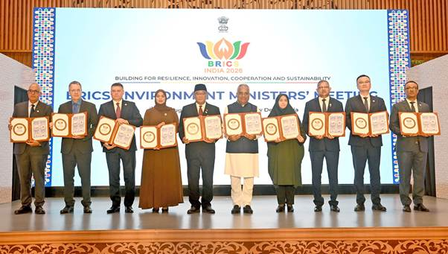
New Delhi, Aug 18 (IANS) BRICS member countries have unveiled four collaborative knowledge compendiums on sustainable lifestyles, integrated wildfire management, landscape-based greening and circular economy practices, the Ministry of Environment, Forest and Climate Change (MoEFCC) said on Tuesday.
The compendiums were unveiled at the 12th BRICS Environment Ministers’ Meeting held under India’s BRICS 2026 Chairship, with Union Environment, Forest and Climate Change Minister Bhupender Yadav and Heads of Delegations from BRICS member countries participating in the meeting.
The ministry said the four knowledge products are the outcome of deliberations under the BRICS Environment Working Group and bring together national experiences, leading practices, innovative solutions and local knowledge systems from member countries.
The Compendium on National Experiences, Leading Practices and Success Stories on Promoting Sustainable Lifestyles brings together case studies from Brazil, China, Egypt, Ethiopia, India, Indonesia, South Africa and the UAE.
It documents initiatives aimed at translating sustainable lifestyles into practical action through policy innovation, behavioural change, environmental education, community participation, sustainable consumption and production, circular economy approaches, ecosystem restoration and clean-energy transitions.
India’s contributions include Mission LiFE, the Environment Education Programme and the SAMBHAV Campaign, reflecting a citizen-centric approach towards promoting sustainable lifestyles. The compendium emphasises how individual choices, market shifts and policy frameworks can work together to drive broader environmental transformation.
The second compendium focuses on Best Practices and Innovative Approaches for Integrated Wildfire Management. The ministry said changing climate conditions, prolonged droughts and rising temperatures are increasing the frequency and intensity of wildfires, posing growing risks to ecosystems, biodiversity, livelihoods and communities.
The compendium brings together approaches ranging from community-led prevention and indigenous knowledge to early warning systems, technology, preparedness and coordinated response. It seeks to promote cooperation among BRICS nations across the entire wildfire-management cycle, from prevention and early warning to response and recovery.
The third Compendium on Integrated Landscape-Based Greening Approaches highlights experiences and policy approaches to address land degradation, desertification, biodiversity loss and climate change. It showcases landscape-based interventions that combine ecosystem restoration with biodiversity conservation and identifies areas for greater BRICS cooperation in knowledge sharing, capacity building, technical cooperation, collaborative research and common monitoring and assessment approaches.
–IANS
pk