

New Delhi, Aug 16 (IANS) When politics starts looking like a circus, it is time to ask whether we have forgotten what the Opposition is actually meant to do. There is nothing wrong with criticising a government or holding protests, an essential part of democracy. But when the issue takes a back seat, and the camera, the clicks, and views become more important than the cause, it indicates that something has clearly gone wrong.
Over the past few months, we have seen shouting, mockery, personal attacks and political theatrics. And all this is happening in the 80th year of India’s Independence.
Eighty years after the freedom struggle, one would expect our politics to have acquired some wisdom and maturity. Instead, at times, it appears to be competing with a comedy show for attention.
The question is not whether the Opposition parties should oppose. Of course they should. The question is how far they should go — and what kind of example they are setting while doing it.
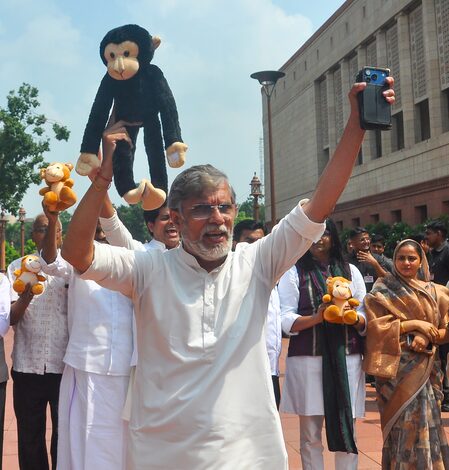
During the Monsoon Session of Parliament, the Opposition repeatedly disrupted proceedings, with ruckus inside the Lok Sabha and Rajya Sabha and protests on the Parliament premises. There is nothing unusual about the Opposition protesting. That is their job. But there comes a point when a protest stops being about the issue and becomes a performance with a particular motive aimed at denigrating.
Some recent scenes in the Parliament complex were almost abusive and not rightly intended. Independent MP Pappu Yadav, dressed in saffron robes, performed a mock act involving a priest and money and was joined by Rahul Gandhi, Samajwadi Party leaders and others. Congress MP Pawan Khera led a demonstration by some Congress and Samajwadi Party members carrying toy monkeys and raising slogans against the Prime Minister.
Perhaps such protests get attention. Perhaps they make for good social media clips. But what do they actually add to political debate?
The same question arises over the Congress’ ‘Rachnatmak Congress National Convention’ at Constitution Club on August 13, where Rahul Gandhi and senior Congress leader Sandeep Dikshit made comments and gestures concerning Prime Minister Narendra Modi and Italian PM Giorgia Meloni that attracted criticism.
On Independence Day, Congress National President Mallikarjun Kharge and Rahul Gandhi stayed away from the main ceremony at the Red Fort led by PM Modi for the second consecutive year. The reason was reportedly linked to seating arrangements. Rahul Gandhi wanted a front-row seat, while the government followed the Table of Precedence, which determines seating and protocol at official functions based on Constitutional position and office.
One may disagree with the arrangement. One may even protest against it. But Independence Day is not a party function. It belongs to the country. Boycotting it was not a positive criticism.
Then came the controversy at the Congress headquarters in New Delhi over Vande Mataram. Videos from the event appeared to show party president Mallikarjun Kharge and Congress Parliamentary Party chairperson Sonia Gandhi making gestures that seemed to ask workers to stop the national song rendition. Rahul Gandhi too appeared to make a similar gesture moments later.
Congress, however, denied that Sonia Gandhi had sought to stop the full rendition. But the visuals have already raised questions and sparked a debate.
And if the Congress has taken Opposition politics into the territory of political theatre, the CJP-led Jantar Mantar protest offers another example of how a genuine issue can get overshadowed by the spectacle surrounding it.
What began as a protest over an issue concerning students attracted support from political groups, NGOs and several other voices. That, however, raises a question now: why is the same enthusiasm not visible when students in Jharkhand, Punjab, Kerala or Karnataka are struggling with their own problems?
The situation of protesting students in Jharkhand is particularly disturbing. They have faced police action, criminal cases and harassment. In Punjab too, there has been a complete denial by the AAP government, and it took the Punjab and Haryana High Court to step in. Even then, the government appears unmoved.
And, where are the voices that were so loud during the CJP protest? Where are the political groups and lobbies that made the Jantar Mantar protest such a major issue? Their silence on Jharkhand and Punjab is difficult to ignore. None of the CJP leaders, for instance, has gone to Jharkhand and sat with the protesting students. Instead, CJP leaders have continued to travel elsewhere, with specific tasks.
Even the behaviour of some CJP leaders has started to raise questions. CJP co-convenor Ashutosh Ranka threatened a police officer in Rajasthan’s Alwar while invoking the resignation of Dharmendra Pradhan as the Union Education Minister after the Jantar Mantar protest. Earlier, CJP convenor Abhijeet Dipke was seen yelling at a police sub-inspector assigned to his security detail.
If the CJP, whose source of funding has itself become a subject of discussion, has turned abusive or filthy behaviour into some kind of political necessity, it raises a larger question about the standards being set by political movements today.
The larger question, however, is not about one protest, one gesture or one political party. It is about where our political culture is heading.
Political opponents will fight. Governments will make mistakes and must be questioned. Leaders will disagree, sometimes strongly. That is democracy. But disagreement does not have to mean disrespect.
A protest can make its point without becoming a performance for the cameras. Criticism can be strong without becoming abusive. Political rivalry can be fierce without turning into a competition over who can create the bigger controversy.
Unfortunately, this is the example being set before the younger generation. Gen Z and Gen Alpha are growing up in a world where almost every political incident reaches them through a short video, meme, reel or social media post. They may not read the entire debate in Parliament or know the details of an issue. But they will see the shouting, mockery, abuse and spectacle. Those are the things that stay with them. And that should worry us.
If today’s political leaders teach the young that shouting is debate, abuse is criticism, and disruption is protest, we should not be surprised if this becomes the new normal.
Was this kind of politics and negativity hinted at by PM Modi when he mentioned the ‘dimagi Naxal’ in his Independence Day speech?
(Deepika Bhan can be contacted at deepika.b@ians.in)
–IANS
dpb/sd/