

New Delhi, Aug 13 (IANS) The Inter-Services Intelligence (ISI) has been restructuring its entire overground worker (OWG) network in Jammu and Kashmir following the setback Pakistan suffered during Operation Sindoor last year.
The operation, launched by the Indian armed forces in response to the Pahalgam terror attack, destroyed terror infrastructure in both Pakistan and Pakistan-occupied Kashmir (PoK).
The setback prompted a major restructuring exercise by Pakistan, which also involved rebuilding the terror infrastructure of Jaish-e-Mohammed (JeM), Lashkar-e-Taiba (LeT) and Hizbul Mujahideen.
Officials say that the OWG network in Jammu and Kashmir operates very differently today.
The first step taken by the ISI was to dismantle its old guard. It then began recruiting young people, including girls, into its overground worker (OWG) network. Most of those recruited are teenagers, aged between 15 and 16 years. Unlike the new recruits, the old guard had been appointed organisation-wise.
“For instance, Jaish and Lashkar would have independent networks of OWGs, and their work would never overlap,” the official explained.
The old guard also had an ideological link to the terror group they were associated with. Moreover, these persons had extensive knowledge of the respective terror groups, including details about their leadership and local handlers, the official said.
For the ISI, it was important to replace the old guard as almost all of them had police records, making it easier for security agencies to identify and track them.
Another aspect about the old guard was that they would be used for multiple assignments. Today’s OWGs who have been recently appointed by the ISI carry out one task and then vanish. This makes detection hard.
An Intelligence Bureau official said the new OWGs are given specific assignments and are primarily tasked with transporting small consignments containing one or two pistols. They are not assigned to carry larger firearms such as AK-47s, the official said.
The official further explained that once an OWG is handed a weapon, he or she is given the location where it has to be delivered. Another OWG would be waiting at the designated spot to receive the weapon and then pass it on to an agent. The agent would then be responsible for delivering it to the person tasked with carrying out the attack.
Another official said that in some cases, a consignment changes hands three times, while in others, it could pass through four or even five different hands apparently to evade security checks.
“This constant changing of hands has posed a big challenge for the security agencies. Keeping track of four to five hands becomes difficult. This strategy also helps the OWGs evade detection as they hardly leave any trail. The fact that they have no files on them and will not be used for another assignment makes tracking even harder,” the official said.
The ISI has ensured that weapons in very small quantities are delivered point to point. The success of such a mission is higher, and chances of them getting caught are much lower, the official also said.
“Pakistan is not aiming for a big hit in the Valley. The very fact that they are choosing pistols over the AK-47 suggests that the aim is to carry out targeted killings and not indulge in a major strike,” the officials said.
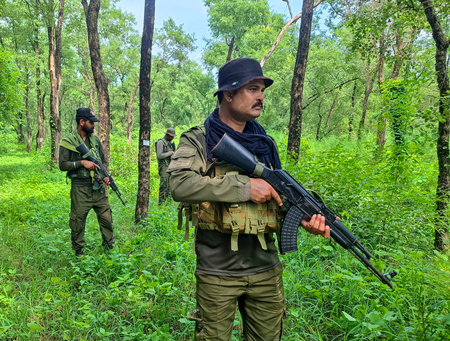
The two recent attacks in Kashmir, in which a head constable and two migrants were killed, indicate the ISI’s intentions. While smaller attacks are one part of the plan, it is suspected that the ISI is also focusing on jungle warfare. Several terrorists are believed to be hiding in the dense forests of the Valley, where security operations are challenging because of the difficult terrain and thick vegetation.
Further, tracking terrorists in the jungles is also difficult because they have been using Chinese-made communication devices such as the Ultra Sets. These combine smartphone functionality with military-grade radio tech.
An official said that this allows terrorists to communicate off-grid without having to use local telecom or SIM card networks.
“These devices do not talk to each other directly, but send short encrypted data bursts via radio waves to cross-border relay stations and Chinese military communications, which are linked to master servers in Pakistan,” the official noted.
–IANS
vn/snj/skp