
Consensus reached on return of stolen cultural assets at BRICS meeting, says Shekhawat

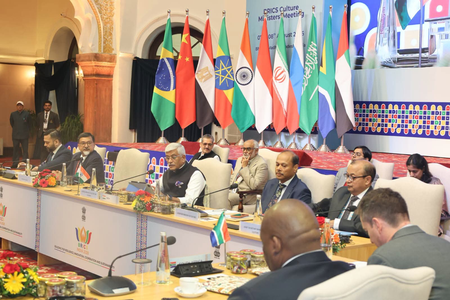
Jaipur, Aug 8 (IANS) The three-day series of BRICS meetings on culture, held under India’s chairmanship, concluded in Bhopal on Saturday with the adoption of the Bhopal Declaration.
At the 11th BRICS Meeting of Ministers of Culture, member and partner countries agreed on a practical and forward-looking framework to strengthen cooperation in culture, heritage, arts, creative industries and cultural exchange.
Addressing a press conference after the meeting, Union Minister for Culture and Tourism Gajendra Singh Shekhawat said the Bhopal Declaration was not merely a statement of intent but an outcome-oriented document that lays down specific objectives and a roadmap for their implementation.
Briefing the media on Saturday, Shekhawat added that the first meeting of the BRICS Culture Group was held virtually on April 29–30, followed by the second meeting of the working group in Varanasi on June 4–5.
The Ministerial meeting in Bhopal built upon the deliberations held during these earlier meetings, culminating in the adoption of the Bhopal Declaration.
He said that 14 countries, including India, participated in the Ministerial meeting in Bhopal, comprising 10 BRICS member countries and four partner countries.
A total of 55 delegates attended the meeting.
During its chairmanship, India anchored the Culture Group’s agenda around “building a strong foundation for resilience, innovation, cooperation, and sustainable development”.
Shekhawat said the objective was to promote cultural cooperation that is sustainable, practical and capable of effective implementation.
The restitution of cultural assets was among the key issues discussed at the meeting.
Countries reached a consensus on strengthening cooperation for the repatriation of archaeological and cultural artifacts that have been stolen or illicitly trafficked from their countries of origin.
Shekhawat said cultural assets are not merely of economic value but represent the sentiments, history and heritage of nations, societies and communities.
“Their (cultural assets) return, therefore, is also a matter of cultural justice.”
The Union Minister highlighted India’s efforts in this regard, saying that before 2014, when Prime Minister Narendra Modi assumed office, only 13 archaeological and cultural treasures had been successfully brought back to India from abroad.
The number has now crossed 700, Union Minister Shekhawat said, expressing confidence that the figure could reach 1,000 by the end of this year at the current pace of efforts.
A significant feature of the Bhopal Declaration is its outcome-oriented approach.
Shekhawat said that, unlike declarations that often remain confined to broad principles, the present document focuses on specific targets, implementation pathways and future action.
The declaration seeks to strengthen the institutional framework for cultural cooperation among BRICS countries and establish a shared roadmap covering traditional and contemporary areas of culture and heritage.
Special emphasis has been placed on cultural and creative industries.
The discussions also focused on creating new opportunities for artists, creators and craftspeople in the expanding global creative economy.
Member countries discussed sharing best practices, strengthening artist networks, learning from each other’s experiences and exploring ways to connect artists and craftspeople with new markets through digital platforms.
The objective, Shekhawat said, extends beyond government-to-government cooperation and aims to strengthen connections between artists and people, thereby taking cultural diplomacy to the grassroots.
A proposal put forward by India to establish a Voluntary Artist Registry received the support of all partner countries at the Bhopal meeting.
The proposed registry will help connect professionals from the cultural and artistic sectors across BRICS countries.
It is expected to facilitate opportunities for artists to work in other member countries, showcase their work and explore new avenues for collaboration.
Shekhawat said the initiative would strengthen networks among artists and promote a sustained process of cultural exchange.
It would also enable artists from BRICS countries to learn from one another’s traditions and experiences while creating opportunities for joint creative projects.
The Bhopal Declaration also places emphasis on strengthening cooperation in UNESCO’s multilateral nomination process.
Shekhawat said greater opportunities for collaboration could emerge when countries jointly nominate cultural and historical heritage sites that have shared significance.
Against this backdrop, BRICS countries will seek to strengthen cooperation for the preservation, promotion and international recognition of shared cultural heritage.
The initiative is expected to further deepen cultural ties among member and partner countries while contributing to the protection of heritage of common historical and cultural value.
The Bhopal Declaration, Shekhawat said, is expected to provide a new direction to cultural cooperation among BRICS nations by combining institutional collaboration with practical initiatives for artists, cultural practitioners, heritage conservation and the creative economy.
–IANS
arc/khz
