

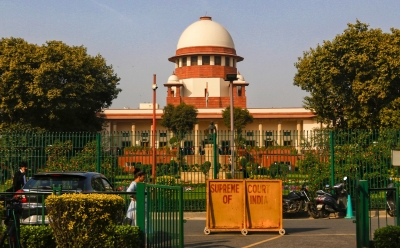
New Delhi, Aug 6 (IANS) The Union government has opposed before the Supreme Court a plea seeking implementation of the “creamy layer” principle in reservations for Scheduled Castes (SCs) and Scheduled Tribes (STs), contending that such a policy change cannot be directed through judicial intervention and must be preceded by a comprehensive empirical study.
In a counter affidavit filed before the apex court, the Union Ministry of Social Justice and Empowerment said the writ petition seeks a mandamus directing the executive to frame a reservation policy in a particular manner, which is beyond the scope of judicial review.
“The present writ petition is not maintainable in law as it essentially prays for issuance of a mandamus to the executive to frame policy in a particular manner, which is beyond the judicial domain,” the affidavit said.
The Centre submitted that the criteria for inclusion in the lists of Scheduled Castes, Scheduled Tribes and Other Backward Classes (OBCs) are founded on historical, social and educational backwardness rather than economic status alone.
“The identification of Scheduled Castes (SCs), Scheduled Tribes (STs), and Socially and Educationally Backward Classes (SEBCs)/Other Backward Classes (OBCs) is based on historical and social criteria like caste, tribe, and social backwardness, not solely on economic status,” the affidavit stated.
It added that the objectives of reservation for SCs, STs and OBCs are to achieve social equality and justice, overcome historical disadvantages and discrimination, and promote inclusive participation in education and public employment.
The Centre further argued that discrimination against SC, ST and OBC communities “does not happen on the basis of economic conditions” alone and that reservation seeks to address historical marginalisation.
The affidavit said that although a means test exists in several welfare and development schemes for SCs, STs and OBCs, reservation in educational institutions and public employment stands on a different footing.
“In majority of schemes of welfare and development of Scheduled Castes, Scheduled Tribes, and Socially and Educationally Backward Classes excepting reservation in educational institutions and reservation in services under the State, there is means test which ensures that benefits of schemes percolate to those who actually deserve them,” it said.
Referring to judicial precedents, the Union government said the Constitution Bench judgment in Indra Sawhney had confined the creamy layer principle to OBCs and had expressly observed that the discussion had “no relevance” in the case of SCs and STs. It also cited subsequent rulings to contend that the creamy layer principle has not been held applicable to Scheduled Castes and Scheduled Tribes.
The Centre further submitted that any proposal to introduce income-based preferences within reserved categories should follow “a holistic review and thorough empirical study, including socio-economic data of reserved category beneficiaries”.
Highlighting the limited scope of judicial review in policy matters, the affidavit relied on several Supreme Court decisions to argue that courts cannot direct the executive to frame policy in a particular manner unless it violates constitutional or statutory rights.
“It is not in the domain of the courts to embark upon an inquiry as to whether a particular public policy is wise and acceptable or whether better policy could be evolved,” the affidavit quoted from an earlier top court judgment, adding that courts can interfere only where a policy is arbitrary or unconstitutional.
Calling the petition “devoid of merit”, the Centre urged the apex court to dismiss it, saying the plea neither demonstrates infringement of any fundamental right nor discloses grounds warranting issuance of a writ under Article 32 of the Constitution.
Earlier, the Supreme Court had issued notice to the Centre and all state governments on a public interest litigation (PIL) seeking implementation of the creamy layer principle in reservations for SCs and STs. It had sought responses on petitions contending that socially and economically advanced families within SC/ST communities continue to corner reservation benefits generation after generation, depriving the weakest sections of affirmative action.
The petitions relied upon the Constitution Bench decision in State of Punjab vs. Davinder Singh, delivered on August 1, 2024, in which a majority of judges favoured application of the creamy layer principle while permitting sub-classification within Scheduled Castes.
However, soon after the verdict, the Union government maintained that the Constitution does not provide for a creamy layer within SC/ST reservations.
–IANS
pds/uk