
India surpasses US to become world’s second-fastest growing solar energy market

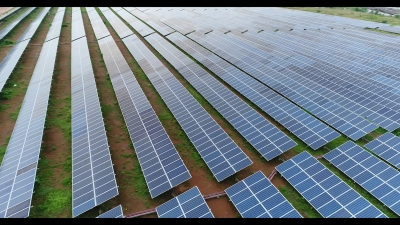
New Delhi, Aug 2 (IANS) India’s installed solar power capacity has surged by a massive 50-fold from a mere 3 GW in 2014 to scale the 162.15 GW mark till June 30, 2026, marking the dawn of a new era in renewable energy, according to a factsheet issued by the government on Sunday.
The country added 37 GW of solar capacity in 2025, surpassing the United States in annual additions to emerge as the world’s second-largest solar growth market, it said.
One of the most significant developments in the solar sector has been the decline in power tariffs over the past decade. This was driven by bidding through the e-Reverse Auction mechanism, where developers compete to supply electricity at the lowest tariff. As more developers participated, the tariffs declined from around Rs 18 per unit in 2010 to a record-low of Rs 2.44 per unit.
The decline in tariffs has made solar power increasingly affordable. As a result, India has emerged as one of the world’s lowest-cost solar power markets. In 2025, the Levelised Cost of Electricity (LCOE) from utility-scale solar PV stood at $35 per MWh, well below the global average of $44 per MWh.
India’s solar sector has received a major boost with the approval of the Pradhan Mantri Surya Sarovar Yojana (PM-SSY) on July 31, 2026. The scheme aims to support 5,000 MW of Floating Solar Photovoltaic (FSPV) projects with co-located Energy Storage Systems (ESS). The ESS with a minimum storage capacity of two hours (10,000 MWh) will further help states manage peak demand. By utilising existing reservoirs and industrial ponds, the scheme will reduce pressure on scarce land resources. It will also improve grid reliability through integrated energy storage. With an outlay of Rs 5,070 crore, the scheme will be implemented from FY 2026– 27 to FY 2030– 31.
Large solar projects in India contribute 118.79 GW of installed capacity. Some of the large solar projects include the Bhadla Solar Park (Rajasthan), Pavagada Solar Park (Karnataka), and Rewa Ultra Mega Solar Park (Madhya Pradesh). Rooftop solar systems connected to the electricity grid contribute another 27.88 GW. The remaining capacity comes from hybrid solar projects and off-grid solar systems. Hybrid projects combine solar power with battery storage or other power sources, while Off-grid systems provide electricity in areas not connected to the grid.
Total non-fossil fuel capacity reached 283.46 GW, including 274.68 GW of renewable energy capacity. On 29 July 2025, renewable energy sources met 51.5 per cent of India’s electricity demand, the highest monthly share recorded so far.
At COP26 in Glasgow, India announced the Panchamrit goals, which include 500 GW of non-fossil fuel capacity by 2030 and net-zero emissions by 2070. These commitments were reflected in India’s updated Nationally Determined Contributions under the Paris Agreement.
–IANS
sps/vd