
Uneven rainfall aids field preparation in TN’s Nagapattinam, but farmers undecided on samba cultivation

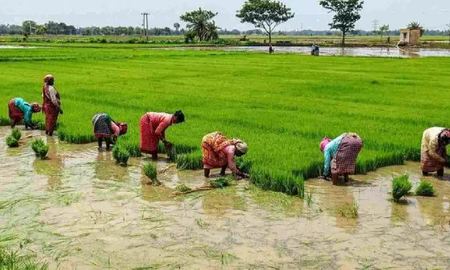
Nagapattinam, July 13 (IANS) Scattered rainfall across Nagapattinam district in Tamil Nadu has brought some relief to farmers by improving soil moisture and enabling summer ploughing in several areas. However, uncertainty over irrigation water availability has prompted many cultivators to postpone final decisions on the extent of samba cultivation this season.
According to district administration data, the district recorded an average rainfall of 7.6 mm during the 24 hours ending at 6 a.m. on Sunday. The rainfall, however, was unevenly distributed across the district.
Nagapattinam taluk recorded the highest average rainfall of 36 mm, followed by Vedaranyam with 4.33 mm and Kilvelur with 1.8 mm. Thirukkuvalai did not receive any rainfall during the period. Among the rain gauge stations, Nagapattinam registered 36 mm, Thalaignayar 13.6 mm and Velankanni 3.6 mm.
No rainfall was recorded at Thirupoondi, Vedaranyam, Kodiyakkarai and Thirukkuvalai stations. Overall, the district received a cumulative rainfall of 53.2 mm across its seven rain gauge stations.
The showers have helped improve soil moisture, allowing farmers in several pockets to begin land preparation for the samba season.
Ploughing activities have picked up in areas that received adequate rainfall. However, field operations remain slow in many parts of the district because of the uneven distribution of rain.
While farmers in and around Nagapattinam town have started preparatory work, several villages in the Vedaranyam region continue to wait for more rainfall before beginning cultivation activities.
Agriculture in Nagapattinam is largely dependent on Cauvery irrigation, while saline groundwater in many coastal areas limits the scope for alternative irrigation sources.
As a result, both rainfall and river water play a vital role in supporting cultivation.
With uncertainty continuing over irrigation water availability, many farmers are adopting a cautious approach before commencing large-scale cultivation.
They expect additional rainfall in the coming weeks to improve field conditions further.
The uncertainty has also influenced crop planning. Some cultivators are considering short-duration paddy varieties that mature within 90 to 120 days to reduce weather-related risks, while others are waiting for greater clarity on rainfall and irrigation before deciding whether to cultivate traditional long-duration samba varieties.
Farmers say the next few weeks will be crucial in determining the overall area brought under samba cultivation, with rainfall and irrigation water expected to shape their decisions.
–IANS
aal/dpb