

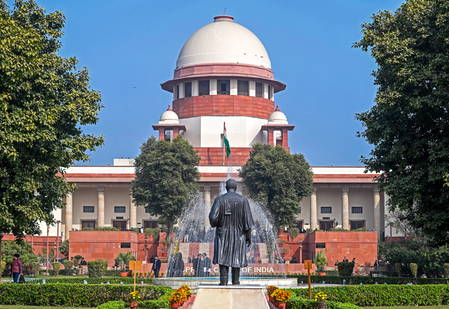
New Delhi, July 9 (IANS) The Supreme Court on Thursday came down heavily on the civic authorities over rampant illegal constructions and repeated non-compliance with its earlier directions, observing that if officials fail to act even after the top court’s orders, it raises serious concerns about the plight of ordinary citizens.
A Bench of Justices Ahsanuddin Amanullah and R. Mahadevan directed the constitution of an expert committee comprising senior professors and draughtsmen from IIT Delhi, who, along with Municipal Corporation of Delhi (MCD) officials and the amicus curiae, will inspect the Saket, Lajpat Nagar, and Sarojini Nagar areas and submit a report before the apex court.
Expressing dissatisfaction with the response of civic authorities, the Justice Amanullah-led bench observed that despite its earlier order directing immediate follow-up action against unauthorised constructions in Delhi, effective measures had not been taken on the ground.
The Supreme Court observed that authorities appeared to have limited themselves to issuing notices instead of taking concrete action such as sealing or demolition, despite earlier directions requiring “immediate and effective measures” against illegal structures.
Taking note of recent fire incidents and building collapses in Delhi, Gurugram, and Lucknow, the top court flagged that ineffective enforcement of building laws could have disastrous consequences and said officials entrusted with implementing its orders would be held personally accountable if they failed to act.
The bench also sought to know the action taken by civic authorities in the wake of recent incidents and indicated that it would not hesitate to initiate contempt proceedings in cases of continued non-compliance.
Earlier, the Supreme Court had directed all states, Union Territories (UTs), and civic bodies to file fresh affidavits personally sworn by the heads of the authorities concerned, disclosing the actual action taken following surveys of unauthorised constructions rather than “mere ritualistic compliance”.
It had clarified that such action should include sealing, demolition or any other measure warranted under law. The apex court had then observed that the scale of violations across the country appeared “enormous”, while specifically flagging Delhi’s Lajpat Nagar and Sarojini Nagar as areas where buildings had allegedly been constructed far beyond sanctioned plans, posing a serious threat of a major calamity.
It had also impleaded the Union Ministry of Housing and Urban Affairs as a party to the proceedings, and appointed senior advocate Ajit Kumar Sinha as the nodal officer to receive complaints relating to illegal constructions.
–IANS
pds/vd