Massive agitation in PoK challenges Pakistan’s Kashmir narrative: Report

Islamabad, July 3 (IANS) Pakistan’s longstanding narrative of representing the interests of Kashmiri Muslims on global platforms while alleging that India violates their rights is increasingly contradicted by the ground realities in Pakistan-occupied Kashmir (PoK).
In the Indian Union Territory of Jammu and Kashmir, Legislative Assembly elections were held in 2024 alongside sustained infrastructure investment. This included the inauguration of the Chenab Bridge in June 2025, the world’s highest railway bridge, linking the region to the national rail network, a report has highlighted.
On the other side of the Line of Control, in PoK, a civic body, the Joint Awami Action Committee (JAAC), demanding affordable electricity, has been designated as a “terrorist organisation”, with communications disrupted in the region and protests suppressed by paramilitary forces.
For nearly eight decades, Pakistan has invoked the ‘Two-Nation Theory’ as the moral and political basis for its occupation of Kashmir. The massive protest in PoK, with crowds of over 70,000 chanting “Pak Forces Out”, has delivered a stark rebuttal to that claim, according to a report in Eurasia Review.
The report noted that amid escalating protests in PoK, Pakistani paramilitary forces opened fire on protesters in Muzaffarabad and Rawalakot last month, killing and injuring dozens of civilians.
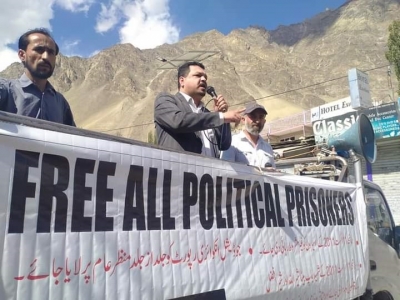
“The demonstrators were traders, students, lawyers, and women demanding affordable electricity and wheat subsidies. The International Human Rights Foundation reported more than 32 civilian deaths between June 8 and June 16, 2026. Protest groups and local media claim the total number of wounded is ranging between 200 and 300. Amnesty International documented internet shutdowns, mass arbitrary arrests, and the application of anti-terrorism law against a grassroots civic coalition. Sit-ins drew over 70,000 at Rawalakot’s Eidgah Ground, with crowds chanting ‘Pak Forces Out’,” it detailed.
According to the report, the unrest in PoK began in 2023 with protests over electricity tariffs and flour shortages organised under JAAC, a coalition of traders, lawyers, transporters, students, and civil society groups.
The JAAC formulated a 38-point charter of demands, including subsidised essentials, local electoral reforms, and the abolition of the reserved 12 assembly seats, which “locals view as diluting their political voice”.
The report underscored a structural dimension to the economic grievance, noting that PoK contributes significantly to Pakistan’s hydropower output, yet its residents pay electricity tariffs well above production costs.
However, consumers in mainland Pakistan, it said, benefit from preferential rates, with the occupied territory that generates power for the state receiving inadequate compensation in return.
Meanwhile, as the unrest in PoK, which has left dozens dead, intensified in recent days, thousands of protesters in Rawalakot on Tuesday declared that the time has come now to free the occupied region from Islamabad’s control.
During a massive protest rally held at the Eidgah Ground, people chanted slogans like “PoK is not part of Pakistan” and “We want freedom”, highlighting that what initially began as a genuine local resistance with demands for reforms has now transformed into an open call for independence from Pakistan’s long-exercised political control over the occupied region.
Experts have repeatedly pointed out that the current political crisis in PoK underscores the deep disconnect between the local population and a “toothless” regional administration that remains entirely subservient to Islamabad.
They reckon that the Pakistani authorities’ decision to ban the JAAC and deploy lethal force in the occupied territory reflects a broader military-driven strategy to suppress the growing unrest in the region.
–IANS
scor/as/ksk