
NCB stresses stronger inter-agency coordination to curb drug trafficking in NE

Aizawl, July 2 (IANS) The Narcotics Control Bureau (NCB) on Thursday emphasised that robust inter-agency coordination remains the cornerstone of India’s efforts to combat drug trafficking and realise the vision of a ‘Drug-Free India’.
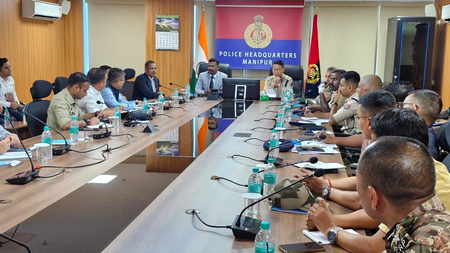
To further strengthen coordination among enforcement agencies, the NCB held the quarterly state-level Joint Coordination Committee (JCC) meeting for Manipur at the state Police Headquarters in Imphal on Thursday.
According to a post on the NCB’s official X handle, the meeting was chaired by NCB Deputy Director General (Northeast Region) R. Sudhakar and attended by senior officials of the National Investigation Agency (NIA), Directorate of Revenue Intelligence (DRI), Enforcement Directorate (ED), Income Tax Department and Customs. The meeting was also attended by senior officials of the Assam Rifles, Border Security Force (BSF), Central Reserve Police Force (CRPF), Railway Protection Force (RPF), Bureau of Civil Aviation Security (BCAS), Anti-Narcotics Task Force (ANTF), Manipur, Subsidiary Intelligence Bureau (SIB) and other law enforcement agencies.
The NCB said that the discussions focused on the prevailing narcotics scenario in the Northeast, emerging trafficking patterns, evolving modus operandi, newly identified trafficking routes and the need for intelligence-driven and coordinated enforcement measures.
The meeting also reviewed major narcotics cases, with particular emphasis on investigations into transnational drug syndicates and the identification of interstate and international linkages.
Deliberations further covered intelligence sharing, joint interrogation of arrested traffickers, coordinated operations and financial investigations aimed at dismantling organised drug trafficking networks, the Bureau said.
Meanwhile, NCB Deputy Director General (Northeast Region) R. Sudhakar on Wednesday met Manipur Chief Minister Yumnam Khemchand Singh and discussed measures to intensify anti-drug initiatives in the state.
The Chief Minister reiterated that his government remains firmly committed to eradicating the drug menace through coordinated, sustained and multi-agency efforts.
An official of the Chief Minister’s Office (CMO), quoting Singh, said that the state government is resolutely pursuing its fight against drug trafficking and narcotics abuse through a comprehensive strategy involving both enforcement and intelligence-based operations.
The meeting between the Chief Minister and the NCB official focused on strengthening intelligence gathering, enhancing coordination among state, Central and international agencies, and ensuring the effective enforcement of the Narcotic Drugs and Psychotropic Substances (NDPS) Act, 1985, to curb drug trafficking and dismantle narcotics networks operating in the region.
Both Manipur and Mizoram have emerged as major drug trafficking corridors in the Northeast because of their long unfenced international borders with Myanmar, which forms part of the notorious “Golden Triangle”, one of the world’s largest illicit narcotics-producing regions.
Five districts of Manipur, Churachandpur, Tengnoupal, Chandel, Kamjong and Ukhrul, share a 398-km unfenced international border with Myanmar, making them particularly vulnerable to cross-border smuggling of narcotics and other contraband.
Mizoram also remains highly vulnerable to transnational drug trafficking as it shares a 510-km unfenced border with Myanmar and a 318-km unfenced border with Bangladesh.
–IANS
sc/dan