
New Delhi, June 25 (IANS) In the turbulent mid-1970s India, a particular house on Patna’s Jagat Narayan Road used to bustle with activity.
Political leaders of many hues, but opposed to the then Prime Minister late Indira Gandhi’s autocratic rule of the time, would make a beeline, even as crowds of youth activists would fill the premises at all times.
There, in a room, would sit Jayaprakash Narayan – or “JP” — receiving guests, holding meetings, giving directions, listening intently to suggestions — preparing for what he had termed “Sampoorna Kranti” or Total Revolution.
When needed, he would step into an adjacent room for more meetings, and plannings.
Jayaprakash Narayan’s “Total Revolution”, announced in 1974 at Gandhi Maidan in Bihar’s capital, was a holistic call for transformation of India’s political, social, economic, and cultural life.
It went beyond changing governments.
JP envisioned restructuring society itself, combining Gandhian ethics, socialist ideals, and democratic decentralisation. It was a call given during the Bihar student movement when rising inflation, unemployment, and corruption were crushing people, leading to a disillusionment with governance.
JP’s involvement in the Bihar student movement meant that young activists saw him as their leader, fuelling grassroots resistance, that propelled the anti-Emergency movement later.
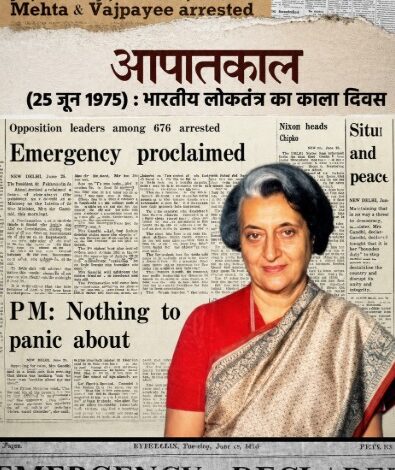
With the imposition of Emergency this day in 1975, when Indira Gandhi suspended many of the fundamental rights guaranteed by the Constitution, JP became the most prominent symbol of resistance.
It is said that the Indira Gandhi-led government was alarmed by JP’s appeal to the armed forces and police to not obey “illegal orders”, and that so shaken was the establishment that it was among principal reasons for declaring Emergency.
Additionally, a nationwide railway strike led by socialist leader George Fernandes paralysed transport and threatened power and steel production which Indira Gandhi saw as a national security threat.
Emergency took away basic fundamental rights, civil liberty organisations were suppressed, and dissenting voices were silenced.
It highlighted how fragile democratic institutions could be when Constitutional safeguards are suspended.
JP’s journey through the 21-month-period was marked by imprisonment, declining health, and yet an unyielding moral authority that galvanised the Opposition.
On the intervening night of June 25–26, 1975, soon after Emergency was declared, JP was arrested under the Maintenance of Internal Security Act (MISA). He was taken to Chandigarh and later shifted to hospital due to his fragile health.
Other Opposition leaders like Morarji Desai, Atal Bihari Vajpayee, and Lal Krishna Advani, among others, were also imprisoned.
JP suffered from kidney problems and other ailments. The imprisonment worsened his condition, and he was eventually released in 1976 on medical grounds.
But his health deteriorated with complications arising from incarceration. He died on October 8, 1979 in Patna at the age of 76; news of his death was reportedly withheld for hours, reflecting the political sensitivities of the time.
Many still question the reason for his death, blaming it on his situation during incarceration.
His death was shrouded in mystery; people remember learning of his passing first on the shortwave radio from news broadcast by an international news agency.
In 1999, JP was posthumously awarded the Bharat Ratna, India’s highest civilian honour.
While incarcerated, JP kept notes that became his ‘Prison Diary’. In it, he described India as “a prison-house of silence” and insisted that the struggle was for the “soul of the nation”. Even from jail, JP’s words inspired students, workers, and political leaders.
His call for Total Revolution became the ideological backbone of the anti-Emergency movement.
His stature as “Lok Nayak” transcended party lines.
Leaders from the Jana Sangh, Congress (O), Socialist groups, even Left leaders, rallied under his guidance. His insistence on unity led to the merger of disparate opposition parties into the Janata Party, which later defeated Indira Gandhi in the 1977 elections.
JP’s ordeal during the Emergency was both physical and political; though frail and ill, he was the tip of the spear, uniting Opposition forces and inspiring ordinary citizens to resist authoritarianism.
Quoting ‘Rashtrakavi’ Dinkar, his thunderous “Sinhasan khali karo, ki janta aati hai (Vacate the throne, the people are coming)” — became the rallying cry against authoritarianism; and it still remains.
On this day, now called “Samvidhan Hatya Diwas (Constitution Murder Day)”, echoes his words “Every nail driven deeper into Indian democracy is like a nail driven into my heart”.
JP’s life remains a testament to courage and moral leadership. His speeches against the Emergency, his call for Total Revolution, and his refusal to compromise with authoritarianism made him the Lok Nayak of India.
–IANS
jb/khz