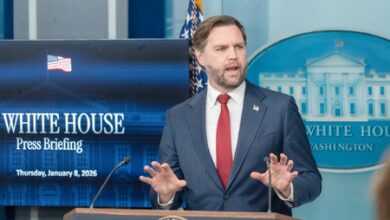

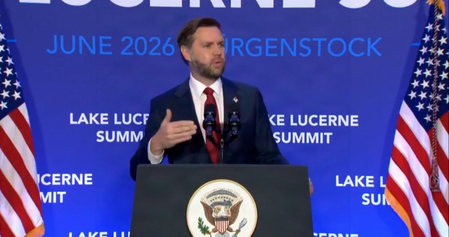
Burgenstock (Switzerland), June 22 (IANS) US Vice President JD Vance said on Monday that Iran has agreed to allow inspectors from the International Atomic Energy Agency (IAEA) back into the country, describing the move as a major breakthrough in negotiations aimed at permanently ending Tehran’s nuclear weapons programme and reducing tensions across the Middle East.
After a fresh round of talks in Burgenstock, Vance told reporters that the development was among the most significant achievements of negotiations involving the United States, Iran and regional partners.
“The Iranians have agreed to invite IAEA inspectors back into their country,” Vance asserted. “That is a major milestone for the American people, and the first step in permanently denuclearising or permanently ending a nuclear weapons programme in Iran.”
He said discussions between Iran and the IAEA could begin quickly.
“I expect that will happen at the minimum this week, but we think even some of those conversations with the inspectors and with the IAEA could happen as soon as today,” Vance said.
The Vice President said negotiators arrived in Switzerland with four objectives: ensuring the Strait of Hormuz remains open, creating a mechanism to prevent future escalation in the Gulf, strengthening regional ceasefire arrangements, and establishing a framework for technical negotiations on Iran’s nuclear programme.
“Yesterday was a very, very good day. We made a lot of good progress,” he said.
Vance said the Strait of Hormuz remained open and negotiators had established a coordination mechanism designed to prevent future disputes from spiralling into wider conflict.
“We wanted to build a mechanism for keeping the Strait of Hormuz open. It is open,” he said.
“So that when there are the conflicts that inevitably come up, we can make sure we work through them rather than that leading to escalation, and that is exactly what we did yesterday.”
He also said technical teams would continue working on details of a broader agreement in the coming days and weeks.
“The way that I think about it is very simple,” Vance said. “We laid a very good foundation for a successful final deal. The final deal is the house. We set the foundation. We haven’t built the house, but we’ve laid a successful foundation to get to a good place for the American people.”
Asked whether President Donald Trump’s latest public threats against Iran had disrupted the negotiations, Vance said they had not.
“No, they didn’t throw a wrench in the system,” he said.
While acknowledging reports that Iranian officials had threatened to leave the talks, Vance said discussions continued late into the night.
“Yes, they did threaten to walk out, or at least there were social media threats that they would walk out, but we were negotiating well past one in the morning yesterday, so they didn’t walk out, and their technical team is still here in Burgenstock.”
“What we told the Iranians yesterday is when you guys engage in what us millennials might call trash talk, you can’t expect the President of the United States not to respond and not to correct the record,” he added.
On Lebanon, Vance said negotiators had made “very good progress” in establishing what he described as a deconfliction mechanism aimed at preventing clashes between Israel and Hezbollah from escalating into a broader regional conflict.
“We’ve been, I think, very good at setting up what we’re calling a deconfliction mechanism,” he said.
Asked whether Washington wanted Israeli forces to leave southern Lebanon, Vance said: “We want Israel’s security to be protected, and we also want Lebanon’s sovereignty to be protected. And this is going to be an ongoing conversation.”
He said the United States remained in contact with regional partners, including Israel, Lebanon, Saudi Arabia and the United Arab Emirates, throughout the negotiations.
Vance also addressed reports regarding frozen Iranian assets, saying Washington wanted safeguards to ensure that any future release of funds would benefit ordinary Iranians rather than support militant activities.
“One of the other things that we wanted to do … we wanted to make sure that we set up a process where if we ever unfreeze Iranian assets, we can ensure that those, that that money, that Iranian money, goes to help the people of Iran and not to fund terrorism,” he said.
–IANS
lkj/ksk/as