
Gandhinagar, June 18 (IANS) The expansion of Gujarat’s metro rail network is transforming daily commuting in Ahmedabad and Gandhinagar, with passengers reporting safer, faster, and more productive journeys as the state’s urban transport system continues to evolve.
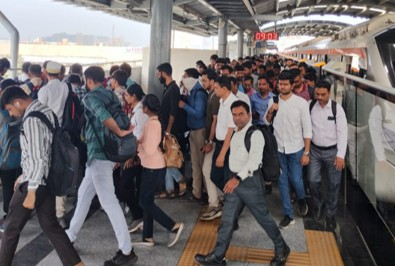
At 8 a.m., as traffic gradually builds on Ahmedabad’s busy roads and the city settles into its daily routine, many metro passengers spend their travel time reading news, preparing for competitive examinations or planning their workday.
The changing scene inside metro coaches reflects a broader shift in public transport usage across the city. Among those benefiting from the service is Richa, a media researcher who regularly commutes between Ahmedabad and Gandhinagar.
Before the metro connection was introduced, reaching her office in Gandhinagar often required changing multiple modes of transport and enduring traffic delays. The launch of metro services between the two cities has significantly altered her daily routine. “Metro has made my travel easy and safe. Because of metro travel, I can make better use of my time,” Richa said.
She now spends her journey reading news reports, carrying out research related to her profession and organising her schedule for the day ahead.
The metro’s impact extends beyond individual commuters. Public transport has become more comfortable and affordable for a wide range of passengers, including students, traders and office-goers.
The Ahmedabad Metro Phase-1 network has brought significant changes to the city’s transport sector by connecting some of its busiest transit hubs and improving accessibility across key corridors.
The network has also helped reduce traffic pressure on major roads such as Ashram Road, C.G. Road and several eastern parts of Ahmedabad, where congestion has historically been a challenge.
The expansion of the Metro Phase-2 network has further strengthened connectivity between Ahmedabad, Gujarat’s economic centre, and Gandhinagar, the state’s administrative capital.
The improved link has made travel more convenient for government employees working at the Secretariat and information technology professionals employed at GIFT City, one of the country’s leading financial and technology hubs.
The developments in Gujarat mirror a wider national expansion of metro rail systems. India now has the world’s third-largest metro network, highlighting the rapid growth of urban mass transit infrastructure in recent years.
The country’s metro network, which stood at 248 kilometres in 2014, has expanded to 1,095 kilometres. During the same period, the number of cities with metro services has increased from five to 26.
Environmental sustainability has also become an integral part of metro development. Metro systems across India are increasingly using regenerative braking technology, which converts kinetic energy generated during braking into electricity. The system helps reduce overall power consumption while contributing to lower carbon emissions.
In Gujarat, metro infrastructure projects have incorporated several environmentally focused features. Four underground stations of the Ahmedabad Metro, Kankaria East, Kalupur, Gheekanta and Shahpur, have received Platinum Certification from the Indian Green Building Council under the Green Mass Rapid Transit System rating framework.
The certification recognises efforts to promote environmentally sustainable infrastructure and energy-efficient operations. Metro expansion has also been linked to domestic manufacturing under the ‘Make in India’ initiative.
Government procurement guidelines provide for at least 75 per cent of metro coaches and 25 per cent of major equipment and subsystems to be sourced domestically, supporting local manufacturing capabilities and reducing dependence on imports.
As part of the continued expansion of urban rail services, the Gujarat government has placed an order for 34 modern metro train sets. The order includes 10 train sets for Ahmedabad Metro Phase-2 and 24 train sets for the Surat Metro project.
The trains are being manufactured at Titagarh’s advanced facility in Kolkata, reflecting the growing role of Indian industry in producing high-technology urban mobility solutions.
–IANS
mys/skp