
World Environment Day: Seed dispersal by sloth bears in Aravalli helps plant species multiply, say researchers

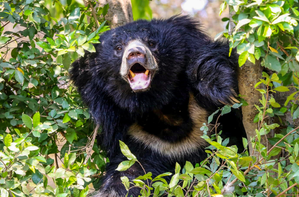
New Delhi, June 5 (IANS) A first-of-its-kind dietary study in a semi-arid deciduous forest of the Aravalli mountains dotted with lakes in the desert state of Rajasthan, indicates that seasonal diet and seed dispersal by sloth bears is helping some plant species in multiplying.
Notably, the germination of the non-native invasive shrub Lantana camara occurred only from scat-derived seeds.
Also, seeds of a few other native fruiting plants also germinated better after being eaten by the bear, suggesting that bears are likely helping structure the vegetation of large landscapes like the Aravallis.
The role of large omnivorous mammals in structuring the vegetation of locations like the Aravallis was very poorly understood in the past. Outside the fruiting season in the dry Aravalli, the researchers found, the bears change their diet to insects and termites, showing how flexible they are in adjusting to strong seasonality.
The study, ‘Seasonal diet and seed dispersal by Sloth bears Melursus ursinus in western India’, which has been accepted for publication in the international journal Biotropica, was undertaken by researchers Utkarsh Prajapati, K.S. Gopi Sundar and Vijay Kumar Koli.
Sundar is an independent researcher, while Koli is a researcher with a university in Udaipur and Prajapati undertook the study as part of his PhD requirements.
The study says large omnivorous mammals can play multifunctional roles in tropical ecosystems by linking trophic processes with plant regeneration dynamics, yet their contributions remain poorly understood in seasonally dry forests.
They investigated seasonal variation in the sloth bear diet and their potential role as seed dispersers in a semi-arid deciduous forest in western India.
Diet was assessed through scat analysis in the winter and summer seasons and seed dispersal effectiveness was evaluated using germination and survival experiments on seeds recovered from scats and those collected directly from plants.
The sloth bear diet exhibited pronounced seasonal shifts, with fruits dominating winter diets and insects constituting a larger proportion during summer.
The fruit consumption was selective and not consistently proportional to availability, indicating preferential foraging.
Seeds of six plant species remained viable after gut passage, with germination success varying among species.
For four species, post-germination survival of seedlings from scat seeds and from plant-collected seeds was not significantly different, while seedlings from plant-collected seeds of donkey berry (Grewia flavescens) and from scat seeds of Coromandel ebony (Diospyros melanoxylon) survived better.
“Our findings demonstrate that sloth bears function as selective seed dispersers, including enhancing the germination success of an invasive shrub in dry deciduous forests. Our findings highlight the importance of increasing focus on how large omnivores influence plant regeneration, thereby potentially affecting landscape-level vegetation dynamics in tropical seasonal ecosystems,” Sundar told IANS.
In seasonal tropical systems where resource availability fluctuates markedly in each season, the ecological roles of mammals can be tightly coupled with dietary plasticity and the ability to track seasonal food resources, says the study.
It says such plasticity can stabilise ecological interactions under variable conditions but can greatly influence patterns of plant recruitment and community composition, particularly in water-limited dry forests.
The sloth bear, a species accorded ‘Vulnerable’ status by the International Union for Conservation of Nature (IUCN) and endemic to the Indian subcontinent, provides a valuable model for examining linkages between seasonal diet composition, resource availability and seed dispersal.
Although morphologically adapted for myrmecophagy, the sloth bear exhibits pronounced dietary variability, incorporating fruits and other plant resources when available.
Previous studies have documented substantial spatial and seasonal variation in the sloth bear diets across India. Most of the previous studies have, however, focussed on diet composition with very few explicitly assessing food selectivity, resource tracking, or functional consequences such as seed dispersal.
Very few studies have integrated diet analysis of sloth bears with experimental tests of seed germination and survival, thereby greatly limiting inference about the ecological significance of fruit consumption by the sloth bears, say researchers.
(Vishal Gulati can be contacted at vishal.g@ians.in)
–IANS
vg/rad