
Ritabrata Banerjee’s journey in keeping with broader transformation of West Bengal politics

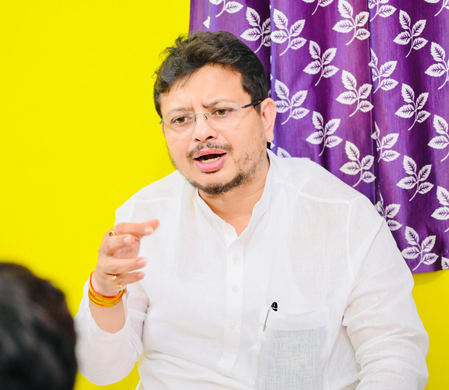
New Delhi, June 3 (IANS) Ritabrata Banerjee, till now a politician who largely remained in shadows — except when mired in allegations and controversies — has evolved this week as the face of a massive rebellion within the Trinamool Congress.
His initial ascent was marked in the Communist Party of India-Marxist (CPI-M) from becoming the all India General Secretary of Students Federation of India (SFI) to his nomination to Rajya Sabha.
His subsequent expulsion over allegations of a “lavish lifestyle”, amidst reports of romantic affairs, did stem the rise later.
Some insiders claim that Anil Biswas, the then Secretary of the State CPI-M unit, played mentor to Banerjee.
Others say that it was the Left Front’s last Chief Minister Buddhadeb Bhattacharjee, who was behind his rise in the party.
The CPI-M nominated him to the Rajya Sabha in 2014, making him one of the youngest MPs from West Bengal.
Before his Rajya Sabha berth, Banerjee faced his first major political setback in 2011.
As Left Front candidate for the by-election to Calcutta South Lok Sabha seat — vacated by Mamata Banerjee when she became the Chief Minister — he lost to Subrata Bakshi of the Trinamool Congress.
In April 2013 a controversy erupted when Banerjee, along with other SFI members, was alleged to have harassed the then West Bengal Finance Minister Amit Mitra during a protest at New Delhi’s Planning Commission.
This incident foreshadowed the disciplinary troubles that would eventually plague his career in the CPI-M.
The turning point in Banerjee’s political life came in 2017, when allegations of moral turpitude and a lifestyle deemed incompatible with Communist ideology brought him down.
The party suspended him in June 2, 2017, for three months pending investigation.
Subsequently, Banerjee attacked top party leadership in the state as well as the those in Delhi.
The CPI-M recommended his expulsion in September 2017, and Banerjee completed the remainder of his Rajya Sabha term (2014-2020) as an Independent. He later joined the Trinamool Congress in 2018, initially serving as Convener of the newly-formed tribal welfare committee.
His primary task was to spot lapses in tribal welfare schemes and recommend improvements, especially in North Bengal’s tea gardens inhabited by Adivasis (tribals).
Unlike his high-profile SFI days, Banerjee’s early years in Trinamool were marked by working deliberately away from the limelight.
The whisper in party circles was that the post he later received was “reward for his work in the tea gardens of North Bengal the past three years without any fanfare or hype”.
In 2021, he was made General Secretary of the West Bengal unit of Indian National Trinamool Trade Union Congress (INTTUC), and later elevated as the state President.
However, the Trinamool performed poorly in the tea belt in the 2021 Assembly elections, particularly in Alipurduar. Yet, Banerjee’s perseverance paid off when the Trinamool Congress nominated him for the Rajya Sabha by-elections in December 2024, following Jawhar Sircar’s resignation amid the RG Kar rape-murder scandal.
When his term ended, he was recalled to contest this year’s West Bengal Assembly election with rumours of an offer for a Ministerial role.
But the Trinamool suffered an inglorious defeat from the Bharatiya Janata Parry (BJP). And on June 1, Ritabrata Banerjee and Sandipan Saha — both MLAs — were expelled by the Trinamool Congress from primary membership.
The controversy centered on allegations of “forged signatures” on a document sent to the West Bengal Assembly Speaker Rathindra Bose for the appointment of the official Leader of Opposition, his two deputies, and Chief Whip.
The expulsion triggered a major political crisis in the Trinamool Congress, with well more than two-third of the remaining 78 legislators backing Ritabrata Banerjee as the Leader of Opposition in Assembly, sparking speculation of a “Shiv Sena-like party split”.
The 46-year-old politician now stands at an important junction after a journey that reflects the broader transformation of West Bengal politics — from Left dominance to Trinamool hegemony, and now to emerging internal fractures within amidst the rise of the BJP in the state.
–IANS
jb/khz