
Ahmedabad civic body intensifies citywide mosquito control drive, dengue cases down from last year

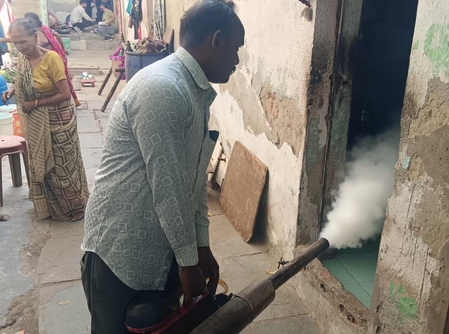
Ahmedabad/Rajkot, May 26 (IANS) The Ahmedabad Municipal Corporation (AMC) has stepped up its pre-monsoon campaign against dengue, malaria and chikungunya across the city, with officials reporting a sharp decline in dengue cases this year amid intensified surveillance, fogging and anti-larval operations.
According to figures released by the AMC, the city has recorded 110 dengue cases between January and May 2026, compared to 1,591 cases during 2025. Of the dengue cases reported this year, 104 were detected in government hospitals and six in private hospitals.
Ahmedabad has also reported 54 malaria (PV) cases and 11 malaria (PF) cases so far this year, against 784 malaria (PV) and 177 malaria (PF) cases recorded in 2025.
The AMC noted that continuous monitoring had contributed to the fall in cases. “Continuous supervision and monitoring compared to last year have resulted in a decline in cases,” the civic body stated.
As part of the pre-monsoon action plan, the corporation has deployed 274 operational fogging machines and around 2,000 staff members across the city, with special focus on high-risk and hotspot areas.
Since January, AMC teams have identified 577 mosquito breeding spots and issued notices and penalties to 88 construction sites for mosquito breeding as well as stagnant water violations.
The corporation said more than 6.53 lakh blood samples have been collected so far this year for dengue and malaria surveillance, while 17,65,047 blood samples were collected during 2025.
AMC clarified that the dengue positivity rate refers to the percentage of people testing positive among those tested for dengue, while the malaria slide positivity rate indicates the percentage of blood slides in which malaria parasites were detected.
Under the campaign, abandoned tyres, scrap materials and water-accumulating waste are being removed across the city, while vegetation and waste are also being cleared from lakes and water bodies to prevent mosquito breeding.
Intensive inspections are being conducted at government and semi-government offices, hospitals, educational institutions, commercial establishments and industrial units.
“Nodal officers had been appointed at these facilities to ensure implementation of civic bylaws related to vector control,” officials said.
The corporation has divided the city ward-wise and zone-wise into smaller operational sections for daily monitoring, with separate mapping prepared for areas reporting high mosquito breeding activity.
Catchpits and drainage systems are being monitored to ensure they remain free from garbage and stagnant water, while insecticide spraying is being carried out regularly.
“Anti-larval operations and fogging drives are conducted throughout the year and intensified during the monsoon period,” the civic body emphasised.
Construction sites, vacant plots and stagnant water points are being monitored every fortnight through an online software-based tracking system.
In slum areas, malaria department teams and urban health centre staff are carrying out regular fever surveillance and anti-larval treatment, while door-to-door checking is being conducted fortnightly in hotspot localities.
Field-level operations are being handled by multi-purpose health workers, malaria workers and ASHA workers, who are conducting household visits for mosquito control, anti-larval treatment, fever surveillance, awareness campaigns and radical malaria treatment.
The AMC said diagnostic and treatment facilities for dengue and malaria are available at all urban health centres, urban community health centres and government dispensaries across the city.
“At present, no outbreak situation has been recorded, though teams have been kept prepared for such circumstances,” AMC stated. Fever surveys and contact tracing are also being carried out in affected areas.
Meanwhile, Rajkot Municipal Corporation (RMC) said it had intensified its own mosquito-borne disease prevention campaign between May 18 and May 24.
The civic body conducted anti-larval operations in 18,261 houses and fogging operations in 171 houses during the period.
Rajkot civic officials said vehicle-mounted fogging machines were deployed in areas with high mosquito density, including sensitive residential societies, public roads and crowded areas.
The corporation also inspected 421 non-residential premises, including construction sites, schools, hospitals, hotels, industries, hostels, scrap yards, religious places, petrol pumps and government offices, for mosquito breeding.
Under bylaw enforcement, notices were issued to 146 residential and 43 commercial entities where mosquito breeding was detected. During the week from May 18 to May 24, Rajkot reported one dengue case and no malaria or chikungunya cases.
Since January, the city has recorded three malaria cases, 15 dengue cases and one chikungunya case.
–IANS
mys/rad