Bengal elections: ‘The Three Musketeers’ of Bengal CEO office managing SIR to counting

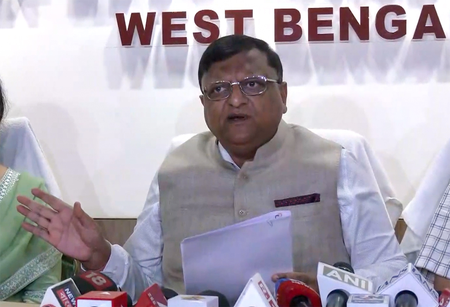
Kolkata, May 5 (IANS) The West Bengal Assembly elections of 2026 have been remarkable from various viewpoints, such as the peaceful polling in contrast to the state’s history of electoral violence and an unprecedented voting percentage. This achievement has been facilitated by three officials in the office of the Chief Electoral Officer (CEO), who have discreetly overseen all operations as behind-the-scenes coordinators from start to finish.
Starting from the special intensive revision (SIR) exercise since November last year to voting and declaration of the results, everything went on so smoothly because of the adept administrative handling by “The Three Musketeers” in the CEO’s office — CEO of West Bengal, Manoj Kumar Agarwal; special poll observer, Subrata Gupta; and special police observer, N.K. Mishra.
The assignment was tough and challenging for the three of them, considering the massive opposition and the hurdles they faced from the ruling Trinamool Congress and the Mamata Banerjee-led government at every stage, right from SIR to the conduct of polling and finally the counting and results.
The challenges faced by the trio from the ruling dispensation were multifaceted, starting from verbal attack to administrative non-cooperation, public maligning on personal issues, and creating legal obstacles.
However, finally, the trio had the last laugh by tactfully and professionally handling each hurdle and ensuring an absolutely peaceful election with the highest polling percentage nationally since independence.
The CEO, Agarwal, a 1990-batch Indian Administrative Service (IAS) officer of West Bengal cadre, was the first choice of the Election Commission of India (ECI) for the chair among the panel of three bureaucrats forwarded by the West Bengal government for that post.
“I have never seen a person of such a cool temperament with the ability of handling difficult situations with professional ease and impeccable transparency. Precisely, that is why every suggestion of Agarwal regarding SIR and polling was accepted by the ECI’s top brass in New Delhi without almost any question asked. In fact, it was his brainchild that the elections this year were conducted in just two phases, compared to six to seven phases in the last few polls,” said another officer from the CEO’s office, who did not wish to be named.
Equally creditable is the ECI-appointed special poll observer, Subrata Gupta, a retired IAS officer of West Bengal cadre, also of the 1990 batch. A technocrat and an alumnus of the Indian Institute of Technology (Kharagpur), Gupta successfully implemented ECI’s programme of making the polling process transparent and peaceful by proper use of technology and application of artificial intelligence (AI).
During the SIR stage, this extensive use of technology and AI applications helped ECI to identify the doubtful voters and successfully weed out the fake ones.
Again, during the polling phases, this same technological application and AI helped the Commission to eliminate poll-related irregularities and misappropriations.
The third and final man of credit is the ECI-appointed special police observer, N.K. Mishra, a retired Indian Police Service (IPS) officer of the Sikkim cadre of the 1988 batch.
Since, as a central sleuth during his service life, he has spent around eight years in West Bengal and knew the state like the palm of his hand, the ECI appointed him as the special police observer for the assembly polls this time.
The officers of the CEO’s office credit him with the effective advance deployment of central forces, force mobilisation, and their effective utilisation on the polling and counting days, thus making the entire polling process absolutely peaceful.
–IANS
src/dpb