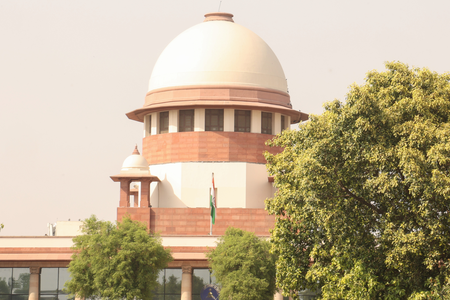
New Delhi, April 30 (IANS) The Supreme Court on Thursday agreed to examine a Public Interest Litigation (PIL) seeking directions to the Centre and states to establish a separate Revenue Judicial Service cadre and prescribe minimum legal qualifications for officers adjudicating land disputes.
A Bench of Chief Justice of India (CJI) Surya Kant and Justice Joymalya Bagchi was hearing the plea filed by advocate Ashwini Kumar Upadhyay, which contends that adjudication of title, succession, inheritance, possession and other property rights by revenue and consolidation officers lacking formal legal education and judicial training violates Articles 14, 21 and 50 of the Constitution.
During the hearing, CJI Kant-led Bench remarked, “The point is very interesting also. But they will say it is for the legislature.”
Appearing in-person, Upadhyay argued that the issue had emerged as one of the most pressing concerns raised by litigants across districts, particularly in rural India. “No, I travel to 2-3 districts every week. Most requests concern this matter. A case has been pending before a Chakbandi Adhikari (consolidation officer) for 40 years to determine which gift deed is valid. This also touches on the separation of powers,” he said.
While orally observing that the issues raised may largely fall within the legislative domain, the CJI Surya Kant-led Bench directed, “Issue notice, returnable in four weeks.”
According to the petition, nearly 66 per cent of civil litigation in India relates to land and property disputes, but such matters are frequently decided at the first instance by executive officers without formal legal training, resulting in inconsistent, delayed and legally flawed decisions.
It argued that vesting adjudicatory powers affecting valuable civil rights in non-judicial officers under executive control undermines the constitutional mandate of separation of judiciary from executive under Article 50.
The PIL has sought directions to the Union and state governments to establish an independent judicial cadre for land disputes, prescribe uniform legal qualifications and judicial training for adjudicating officers, and ensure that such adjudication is supervised by the respective High Courts.
It referred to the principles laid down by the Allahabad High Court in Chandra Bhan vs. Deputy Director of Consolidation (2005), which recommended the creation of a Revenue Judicial Service for the adjudication of complex land disputes.
The petition further contended that the present framework, rooted in colonial revenue administration, causes systemic miscarriage of justice, burdens constitutional courts with avoidable appeals, and disproportionately harms citizens whose livelihoods depend on land rights.
–IANS
pds/dpb