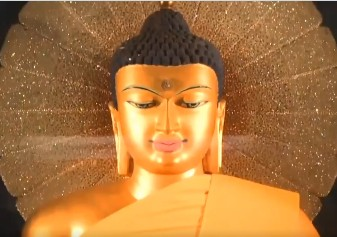
New Delhi, April 26 (IANS) At a time when conflicts are expanding beyond borders and affecting regions far removed from the battlefield, the teachings of Buddha Dhamma offer not only moral guidance but also a practical framework for resolving crises. The present tensions involving Iran, the United States and Israel, along with their cascading impact on energy routes, trade systems and vulnerable populations, underline a deeper failure. It is not merely a failure of diplomacy but a failure to understand interdependence, restraint and the consequences of unchecked greed.
Buddha Dhamma, as preserved in the Nalanda tradition, is not an abstract philosophy. It is a lived and tested approach to human conflict.
Beyond Teaching: Buddha Intervenes
“Conquer anger by non-anger; conquer evil by good; conquer the miser with generosity and the liar with truth.”
The Buddha did not remain a silent observer of conflict. Historical accounts show that he intervened directly to prevent wars. One of the most well-known instances was the dispute over the Rohini River between the Shakyas and Koliyas. Instead of invoking doctrine, he appealed to reason, asking whether the value of human life was worth less than water. The conflict was resolved without bloodshed.
At the same time, there were limits to intervention. When his own clan faced destruction due to their past actions, the Buddha stepped aside, recognising that the law of cause and effect cannot be overridden. This dual approach is important. It teaches that peace efforts must be sincere and persistent, but also grounded in an understanding of deeper causes.
This is where modern conflict resolution often fails. There is intervention without introspection, negotiation without accountability, and strategy without moral clarity.
The Central Problem of Greed in Modern Conflicts
“There is no fire like greed, no grip like hatred…”
Buddha Dhamma identifies greed, hatred and ignorance as the root causes of suffering. Among these, greed has taken a highly organised and sophisticated form in modern geopolitics. It is no longer individual but systemic. It operates through control of resources, trade routes and strategic dominance.
Many contemporary conflicts, including those in West Asia, cannot be separated from competition over energy routes, economic leverage and geopolitical influence. These are often presented as matters of security or national interest, but at their core lies an expansion of desire beyond legitimate need.
Even history supports this understanding. Emperor Ashoka, after the Kalinga war, realised the futility of conquest driven by ambition. He turned to Dhamma as a guiding principle for governance, while still maintaining an army for protection. This distinction remains critical. Defence for protection is fundamentally different from expansion for advantage.
Doctrine of Dependent Origination and Global Interdependence
“Avijja-paccaya sankhara, sankhara-paccaya vinnaṇam, vedana-paccaya taṇha, taṇha-paccaya upadanam, upadana-paccaya bhavo…”
This is not just metaphysics; it is a causal model of conflict:
“With feeling as condition, craving arises;
with craving as condition, clinging arises;
with clinging as condition, becoming arises…”
One of the most profound teachings of Buddha Dhamma is the doctrine of dependent origination. It explains that everything arises in dependence on causes and conditions. Nothing exists in isolation.
In today’s world, this principle is visible in its most tangible form. Energy routes, supply chains and financial systems connect nations in ways that make conflict self-damaging. A disruption in one region affects economies across continents. When shipping lanes are threatened or oil supplies are interrupted, the impact is felt not only by powerful nations but more severely by weaker economies.
Control over resources is pursued as a sign of strength, without recognising that such control creates vulnerability through interdependence.
Nature, Climate and the ethics of shared resources
“One should use wealth…for one’s needs, for supporting others, and for safeguarding the future.”
Buddha Dhamma also emphasises harmony with nature. What is taken from nature without balance returns in the form of suffering. Climate change is a modern expression of this imbalance.
Natural resources were never meant to be monopolised. When they are controlled and monetised beyond equitable limits, it creates structural inequality and conflict. Energy routes, water systems and environmental resources are shared by nature but divided by human ambition.
This raises an important ethical question. What is legal is not always just. True illegality, in a broader sense, lies in violating the natural order that sustains all life.
The present crisis, whether seen through climate stress or geopolitical conflict, reflects a departure from this balance. The more nations attempt to dominate natural systems, the more instability they create for themselves.
Lessons for the Present Iran Conflict
The current tensions involving Iran and its regional and global stakeholders must be seen through this wider lens. The issue is not limited to immediate triggers but extends to long-standing patterns of mistrust, control and strategic competition.
Ignoring the dependence of global systems on stable energy flows and cooperative frameworks is a serious oversight. Nations that appear strong today are equally vulnerable to disruptions tomorrow. The resilience often lies with those who have learned to adapt rather than dominate.
Buddha Dhamma would advise a shift from positional negotiation to understanding causation. Why has the conflict persisted? What interests are being protected? Who bears the cost? Without addressing these questions, any agreement will remain temporary.
A Call for Collective Responsibility
“Whatever one does, good or bad, that one will inherit.”
At this stage, the responsibility does not lie only with governments. It extends to thinkers, religious leaders, philosophers and senior political figures. Silence in the face of escalating conflict is no longer a neutral position.
There is a need for a universal voice that transcends national interests and calls for restraint. This does not mean passivity. It means active engagement to prevent destruction. Even if pressure or force is required, it must be directed towards enforcing peace, not prolonging conflict.
The principle of non-violence in Buddha Dhamma is not weakness. It is a disciplined approach to preventing greater harm. It requires courage to question prevailing narratives and to challenge the structures that benefit from conflict.
Conclusion: The Choice Before Humanity
History has consistently shown that wars are easy to start but impossible to fully control. Once initiated, they develop their own momentum and consequences that extend far beyond original intentions. The lesson is not only political but civilisational. Every major conflict eventually escapes the calculations of those who begin it.
Buddha Dhamma offers a path that is both ethical and practical. Understand the cause, recognise interdependence, restrain greed and act with compassion. These are not idealistic notions but necessary conditions for survival in an interconnected world. The Buddha did not merely preach peace; he demonstrated how conflicts can be diffused by addressing their roots. His intervention in the Rohini river dispute showed that reason and proportion can prevent destruction. At the same time, his decision to step aside in the case of his own clan reflected a deeper truth that actions carry consequences which cannot always be avoided.
Ancient wisdom traditions consistently reinforce this approach. The teaching of dependent origination explains that no conflict remains local. It spreads through invisible chains of cause and effect. This is visible today in disruptions of energy supply, trade routes and economic stability across regions that are not even directly involved in the conflict. Similarly, the principle of non-violence is not passive restraint but an active effort to prevent larger harm. Emperor Ashoka’s transformation after Kalinga remains one of the strongest examples of how power can be redirected from conquest to moral responsibility, while still ensuring protection.
A most relevant teaching of the Buddha comes from the Dhammapada:
“Na hi verena verani sammantidha kudacanaṃ; averena ca sammanti, esa dhammo sanantano.”
Hatred is never appeased by hatred at any time, but by non-hatred alone. This is an eternal law.
This principle is not limited to personal conduct. It applies equally to states and leadership. Retaliation driven by anger only deepens cycles of conflict, while restraint guided by wisdom creates space for resolution. Another teaching from the Samyutta Nikaya on dependent origination reminds us that suffering arises from causes and conditions. Unless these causes are addressed, outcomes cannot change. Modern conflict management often ignores this fundamental truth.
The present moment is a test of collective wisdom. Those who continue to drive the world towards conflict for short-term gains will not escape the consequences. History will judge them not by their power but by the suffering they leave behind.
It is time to return to a universal approach rooted in ancient wisdom. The Nalanda tradition, with its emphasis on reasoning, dialogue and compassion, provides that foundation. The world must raise its voice strongly enough to compel peace. Thinkers, religious leaders, philosophers and senior political figures must step forward with clarity and courage. Silence or neutrality in such times becomes indirect support for destruction.
The world stands at a point where continued escalation can lead to irreversible changes in global order, economy and human security.
The choice is clear. Either humanity recognises its shared dependence and acts decisively for peace, or it allows conflict to expand until it becomes self-destructive. The window for wisdom is still open, but it is narrowing rapidly.
(The author is a former diplomat and strategic affairs expert. Views expressed are personal)
–IANS
scor/uk