West Asia developments raise scepticism on Pakistan’s ability to convert talks into peaceful settlement

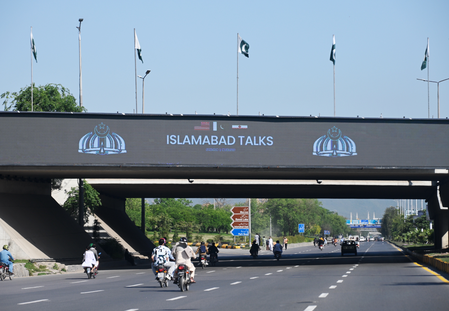
New Delhi, April 22 (IANS) In its attempt at being relevant while seeking economic support, Pakistan looks intent on playing a complicated game of diplomatic checkers where its apparent “peace mediation” efforts appear to contradict its own stand.
The diplomatic push is a pivot for Pakistan, which has spent more time as a combatant over the past year in its own conflicts than as a peace broker, pointed out a report in The New York Times.
Islamabad has a chequered history in Afghan involvement, especially during the Soviet occupation. Lately, it has been conducting a series of airstrikes against Kabul, striking households and even a drug rehabilitation centre. Its active support to terror networks through hosting and training insurgents and launching them into India is a documented fact. Some media reports quote analysts attributing Pakistan’s selection to its shared 900 km border with Iran, working relations with both sides, and geographic edge over traditional mediators like Qatar under Iranian fire.
Through this, United States President Donald Trump’s repeated statements of admiration for Pakistan’s Prime Minister Shebaz Sharif and Army chief, Field Marshal Asim Munir, and Iran’s rejection of sending a delegation to Islamabad for the second round of peace talks raise questions over Islamabad being a “neutral negotiator”.
Additionally, in an exclusive interview to IANS, US former National Security Advisor (NSA) H.R. McMaster cast doubt on its role in Iran-related diplomacy, describing it as a “client” of China and warning of “ulterior motives” in its mediation efforts. McMaster was NSA to President Trump in his first term.
Meanwhile, according to a commentary on the American thinktank Stimson Center this month, “Pakistan’s attempts to court President Donald Trump in his second term did not have a positive start”.
It recounted how, after his last election, close associates of Trump courted Pakistan’s opposition and pushed for the release of jailed former Prime Minister Imran Khan. “However, the real breakthrough happened after a four-day conflict between India and Pakistan in May 2025. Pakistan appreciated President Trump’s role in helping to stop hostilities with India and later formally nominated him for a Nobel Peace Prize. This was followed by Pakistanis pitching deals to the US President and his close associates in the cryptocurrency sector, as well as initiating a partnership to provide critical minerals to the US,” added the article.
Pakistan also buttressed its ties with Riyadh with a defence pact and deployment of troops and war machines in Saudi Arabia. This too is being perceived as a threat to Tehran following its attack on neighbouring US bases.
Signed in September 2025, the agreement stipulates that an attack on either country will be considered an attack on both, which is modelled on NATO’s Article 5 that formalises decades of military cooperation, intelligence sharing, and counterterrorism collaboration. The pact was recently activated operationally following Iranian drone and missile strikes on Saudi territory, marking the first real-world test of its collective security provisions.
Economically, Riyadh provides loans, grants, and investments targeting $75-100 billion in energy, mining, and infrastructure to ease Pakistan’s crises, with remittances from five million Pakistanis in the Gulf equaling export earnings.
Pakistan’s deep relations with Saudi Arabia, which hosts US bases recently attacked by Iran, raise questions about Islamabad’s neutrality. Tehran, despite its ties with Islamabad, thus has reasons to see such developments go against its interests. Its official responses to further peace talks have been dismissive, complicating Islamabad’s role.
Amidst Islamabad’s contradictory moves, McMaster has argued that given Beijing’s vested interest in preserving the current Iranian regime, Pakistan’s offer to broker talks may not be neutral.
Pakistan Prime Minister Sharif, Foreign Minister Ishaq Dar, and other officials have repeatedly framed Islamabad as a neutral facilitator committed to sustained dialogue and regional stability. Pakistan has publicly offered to host further rounds of US-Iran talks and highlighted coordination with China and Gulf partners. Though Islamabad has thus emerged as a central intermediary in the West Asia crisis since February 2026, securing a fragile ceasefire window, it is facing public rebuffs from Tehran and deep scepticism from analysts about its ability to convert talks into a durable settlement.
–IANS
jb/vd