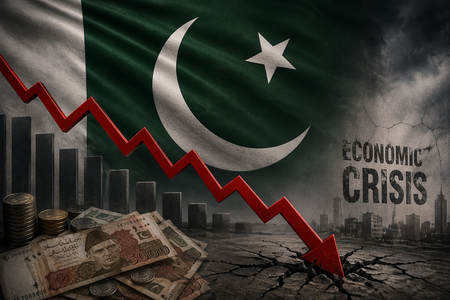
New Delhi, April 21 (IANS) Pakistan has entered more than 20 programmes with the International Monetary Fund (IMF) over 65 years since 1958, and yet continues to remain trapped in a recurring cycle of economic crises, bailouts and temporary stabilisation without achieving durable structural reform, a report has lamented.
According to a report in The News International, latest concerns were reflected in the IMF’s End-of-Mission Statement of March 2026, which once again highlighted familiar priorities such as fiscal consolidation, tight monetary policy, energy sector reforms and managing external financing pressures.
The statement also flagged rising risks from geopolitical tensions in West Asia, elevated energy prices and tightening global financial conditions, it said.
Despite repeated engagement with the IMF, Pakistan has struggled to translate short-term stabilisation into sustained economic recovery.
The report points to deep-rooted structural weaknesses, including weak revenue mobilisation, persistent fiscal deficits, rising debt servicing costs and limited export growth. It also highlighted that total public debt reached Rs 79.32 trillion in January 2026, up from Rs 72.12 trillion a year earlier, an increase of about Rs 7.2 trillion or 10 per cent.
Moreover, the composition of debt has also shifted, with domestic borrowing now accounting for around 71 per cent of the total.
Meanwhile, domestic debt stood at Rs 55.98 trillion, while short-term borrowing remained elevated at Rs 8.78 trillion, pointing to ongoing refinancing risks and external debt stood at Rs 23.34 trillion.
At the same time, the country is required to meet gross external financing requirements of $19.398 billion in 2025-26 and $19.123 billion in 2026-27, even as it manages immediate repayment obligations, including about $3.5 billion due to the UAE.
However, foreign exchange reserves remain under pressure, with total liquid reserves at $21.789 billion as of March 27, 2026, including $16.381 billion held by the State Bank of Pakistan.
Pakistan continues to rely on external support and rollover arrangements from key partners such as China and Saudi Arabia, alongside multilateral assistance, to manage its short-term financing gaps, according to the report.
Additionally, government borrowing has crowded out private sector lending, with more than 80 per cent of bank credit flowing to the public sector.
In 2023, the IMF estimated Pakistan’s debt-to-GDP ratio stood at around 75 per cent in recent years, which is above its legal threshold of 58 per cent, indicating elevated sustainability risks.
–IANS
ag/na